The main roles of the digestive system
The digestive system, with its 100 trillion microbes (bacteria, fungi, viruses, and yeasts) and its 100 million neurons, is referred to as the seat of immunity and the second brain. This is rightly so, as it is connected to all the organs of the body and is capable of producing antibodies, fatty acids, hormones, amino acids, vitamins (such as B and K vitamins), etc. It is also the site of food assimilation and toxin elimination, and it is the one that produces 95% of the serotonin (the happiness hormone) found in our body. Therefore, it is in our interest to understand how it works.
For several decades, with the normalization of industrial and non-physiological food that generates toxins and inflammation, with the frequent use of antibiotics and vaccines that harm the intestinal flora and the immune system, etc., many diseases of the digestive system have emerged. More and more intestines are now in a state of chronic inflammation, contain numerous waste products, and have an unbalanced intestinal flora. Autopsy reports have even revealed that the 600m2 of digestive mucosa can store up to 2 kilos of unwanted waste (fecalomas, gallstones, hardened mucus, dead cells, heavy metals, parasites, etc).
All diseases have an emotional component, and it seems that this is particularly true for intestinal disorders. Moreover, since the digestive system is interconnected with all parts of the body, complementary approaches (on the psychological or postural sphere) sometimes yield good results. Regardless, whether you have acute digestive disorders or not, and whether they are related to external causes or not, there are simple and free good habits that can bring great benefits to your digestive system.
Our education has instilled in us the false belief that what is complex is more effective than what is simple. I am convinced of the opposite. It is nature, with its cycles and elements, that has given us life, and it is she who is best suited to help our body self-heal.
8 simple and natural practices to promote good digestion
- Follow natural cycles by eating between 10 AM and 6 PM (solar time)
We have the biology of a diurnal animal, and our digestive secretions mainly occur during the day, particularly around noon. Therefore, when the sun is high in the sky, the most important meal of the day should take place. Eating at fixed times also facilitates digestion.
- Chew well, without looking at a screen and without talking
Eating should be a meditation where one connects to the sensations that food evokes in the body and where one breathes consciously between each bite. To facilitate stomach work, all solid foods should be made liquid through chewing. It also allows the pancreas and small intestine to estimate how much enzymes, juices, and minerals to release. Furthermore, it is soothing (by activating the hippocampus), increases taste pleasure, and allows for less food intake. The habit that humans have taken to gather around a meal is really to be reconsidered; it is not the place for that!
- Practice abdominal breathing
When done consciously during meals, it activates the parasympathetic nervous system (necessary for digestion) and massages the organs.
- Eat fruits alone and before meals
Because they do not digest in the stomach, where they only transit, but are assimilated in the small intestine. Eating fruits when the stomach is already occupied will cause digestive troubles, especially if you are prone to them.
- Follow good food combinations
The less you transform and mix your foods (4-5 is a maximum), the more digestible your meals will be. Moreover, certain combinations should be avoided, such as: Fat – sweet – salty / fruits – oilseeds / starches – proteins. To learn more, read this article on food combinations.
- Consume plants that promote digestion
All aromatic plants prevent putrefaction and aid digestion. Some are carminative (they purify and cleanse the intestines) like coriander, mint, oregano, anise, basil, etc. Others are choleretic and cholagogue (they promote the production and excretion of bile) like turmeric, ginger, celery, etc. Don’t overthink it; incorporate the ones you like into your foods.
- Be present to yourself
Take at least 10 minutes after the meal to rest while remaining still and aware of the sensations in your body. A 15-minute postprandial walk in full awareness will also be beneficial.
- Familiarize yourself with the squatting position
Practiced for at least 10 minutes a day, it improves breathing, fluid and energy circulation, digestion, and flexibility of the lower back. It is also the ideal position for bowel movements, as explained by Bernatd Clavière in the video below.
Translation note: this video is currently in French, but you can activate YouTube’s auto-generated subtitles in English while we work on providing a dedicated English version.
The importance of good transit
According to statistics, one in three French people suffers from constipation. This means, according to the official definition of the WHO, that a third of the population goes to the bathroom less than three times a week. From a hygienist’s point of view, it is considered that there should be one bowel movement per meal, that is, 2 to 3 times a day; this is the natural rhythm of evacuation according to Mother Nature. Therefore, almost the entire population is constipated…
When we eat raw fruits and vegetables, they are digested and eliminated in 12 to 24 hours depending on whether the transit is functional or slowed. When we eat industrial or cooked food, refined foods low in fiber, or animal products, they remain in the body for 24 to 48 hours.
This non-physiological food (already a source of toxins) that spends a prolonged time in the intestine is subject to fermentation (gas emission) and putrefaction (foul odors), which in turn generate other harmful substances. The many toxins that result from this aggress the intestinal mucosa and alter the quality of the intestinal flora. These repeated indigestions, which often go unnoticed, directly contribute to the formation of mucoid plaque (see image at the bottom right of the article) and lay the groundwork for constipation, assimilation disorders (leading to deficiencies and weight loss), chronic disorders (inflammations), and immunodeficiencies. Hence the importance of promoting a physiological diet (that is, raw plant-based) and good transit on a daily basis.
As with any disease, there is an emotional component, and in the case of digestive disorders, it is generally significant. Stress, fear, and anger, among others, are known to impair the proper functioning of the colon. More generally, all diseases are the symbolic expression, in matter, of our “mal-à-dieu”, or, in other words, of what takes away our joy of living and our peace. Popular expressions say a lot about what “one cannot swallow” or what “one has not digested”. Regarding constipation, it can find its origin in what we hold back (resentment, beliefs, anger, grief, principles, money, etc.) and which poisons our existence.
8 simple and natural practices for good transit
- Drink a glass of warm water in the morning on an empty stomach to stimulate the digestive system. You can add herbal tea, lemon juice, ginger, or seawater.
- Raise your legs on the toilet (so that the colon is straight and not curved) and squat several times a day so that this posture becomes natural.
- Eat at least one kilogram of fruits per day. In addition to providing digestive fibers that will facilitate transit, they contain plenty of energy to promote peristalsis.
- Engage in daily physical activity to stimulate lymphatic circulation, massage the digestive organs, and facilitate peristalsis.
- Practice differential baths or sitz baths with friction daily. According to Louis Kuhne, one of the greatest hygienists of the 19th century, they improve digestion, increase vital energy, and put an end to the most stubborn constipation.
- Consume daily certain foods from this list: ginger or turmeric, psyllium, lacto-fermented vegetables (to rebalance the intestinal flora), aloe vera gel, aromatic herbs, isotonic seawater, and mucilaginous seeds (ground flax or chia).
- Drink infusions of laxative plants after meals (Boldoflorine, Senna, Crepe Mallow, etc).
- Follow the cycles of nature and sleep between 10 PM and 6 AM. Constipation is often linked to a lack of energy.
Is raw food indigestible?
In the hygienist approach, it is considered that diseases and disorders of the digestive system are directly related to the absorption of toxic waste in the intestines and the accumulation of waste in the colon. The inflammation or swelling of the intestinal mucosa that results is a reaction that the body takes when toxins threaten to enter the blood.
Hence the major importance, as we have seen previously, of having a physiological diet based on raw fruits and vegetables. However, many people have difficulty digesting these natural foods, here’s why:
Bloating, irritation, and diarrhea with raw food is normal at first!
All raw fruits and vegetables have therapeutic properties. They notably have the ability to cleanse the intestines thanks to their fibers and certain phytoactive principles (like chlorophyll). This is why they can cause some mild troubles.
Bloating and gas are not due to FODMAPs (natural sugars accused of these ailments) but to three troubles that often occur simultaneously:
- the accumulation of waste at the level of the intestinal mucosa that hinders the passage into the blood of gases naturally produced by bacteria during digestion (about 10L). These digestive gases are normally expelled through the lungs.
- the production of fermentation in the colon due to insufficient chewing, too slow transit, incompatible food combinations, consumption of fruits at the end of meals, etc.
- an unbalanced intestinal flora (due to the putrefaction of animal proteins, consumption of cooked or industrial food, use of medications, etc.) that has not yet adapted to digest more raw plant-based food.
If you experience irritations with raw food, they can have different origins:
- you are consuming more fibers than before, and their cleansing action (like a sponge) irritates your mucosa if it is previously in an inflammatory state.
- the intestinal mucosa swells to detach the putrefactions. This is not pleasant, but it is a necessary evil.
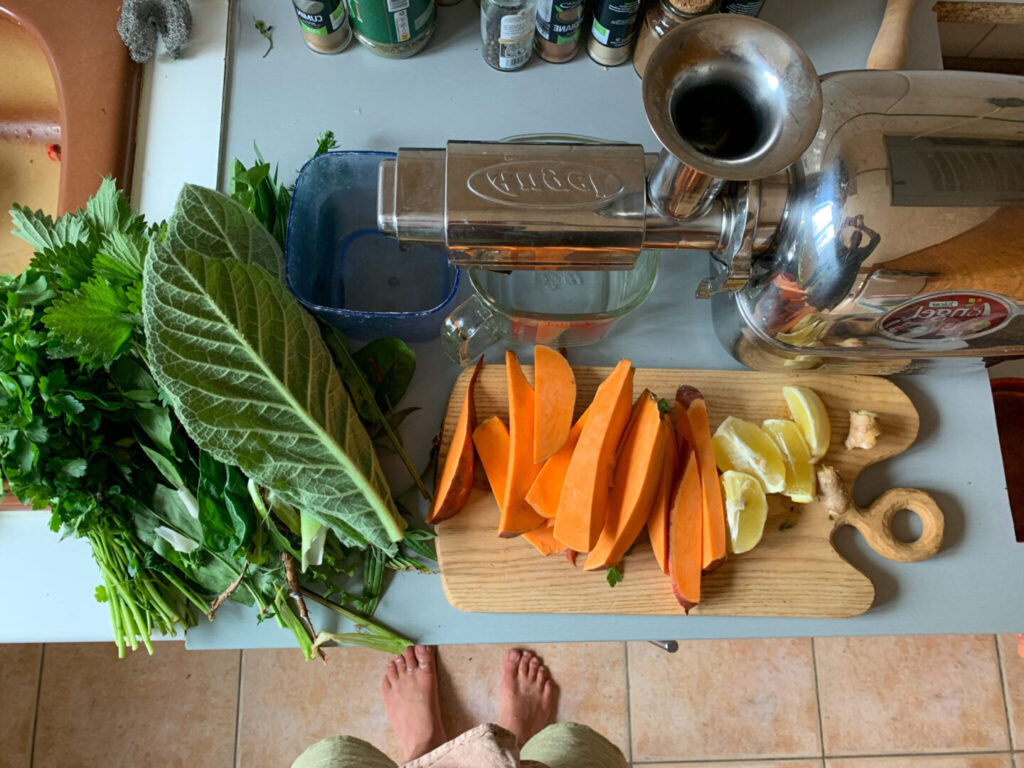
For all these reasons, it is preferable to introduce raw fruits and vegetables gradually (each person should find their own rhythm) so that the previously mentioned troubles have time to diminish and then disappear. Also, know that we are primarily made to consume fruits (whose fibers are gentle) and not large quantities of raw vegetables (whose fibers are rougher, especially for root vegetables). Therefore, as long as you are sensitive to it, do not consume large quantities of vegetables (grated or raw), but prefer them in juice form; juicers were invented for this and will always contain enough (soluble) fibers for transit.
As for diarrhea, it is the cleansing properties of living foods that come into play. First of all, it is necessary to reprogram your beliefs and old reflexes in this area, namely that diarrhea is not a problem in itself (unless it becomes chronic)! It is rather a good thing because it is a clear sign that your body is cleaning itself. If this bothers you, the advice is the same: go gradually.
8 natural and effective tools to cleanse and regenerate the digestive system
For those who wish to go further and also faster in regenerating their digestive system, you will find below tools to handle with discernment.
- Unheated clay internally, due to its adsorption properties, has the power to cleanse the body of its toxins. It also acts as a poultice and is particularly indicated in case of pain to soothe irritated intestines. It can be used in a cure for 3 weeks. From 1 teaspoon to 2 tablespoons (green montmorillonite clay, for example) in a glass of water, to be taken upon waking and before bed. Start gradually before increasing the doses and stop the cure in case of constipation or slowed transit.
- Activated charcoal has adsorption and purification properties similar to clay, except that it does not serve as a poultice at the intestinal level. However, it is capable of absorbing 100 times its weight in gas, making its use wise in case of flatulence. Same dosage as for clay.
- Probiotics, found in fermented vegetables, are useful for cleansing the intestinal flora, cleaning the intestines of putrefactions, and promoting good digestion. They are essential after the use of medications (especially antibiotics).
- Enemas and colon hydrotherapy (which are performed in centers) are very useful for cleansing the colon, an organ that develops very early during embryogenesis and is connected to all others. Generally clogged by deposits of toxins, it becomes a potential source of self-intoxication and cancer (the second most common). Cleansing the colon is a major health practice to regain optimal digestion and prevent constipation.
- Magnesium oxide is a natural substance (found in a metamorphic rock called periclase) that releases oxygen upon contact with stomach acid. Oxygen helps cleanse the intestines (by oxidizing waste) and rebalances the intestinal flora (by weakening so-called pathogenic saprophytic bacteria), a process that only makes sense if conducted alongside an improvement in dietary habits. Magnesium oxide is marketed under various products: Oxy-Powder, Homozon, Oxy-Cleanse, and Aerobic Life Mag 07. Follow the recommended dosage for these products.
- Cleanses help to eliminate certain toxins (acids and glues) and purify the lymph. This is an internal cleansing practice that, if combined with an improvement in dietary habits, allows for a gradual return to a healthy and clean digestive system. To learn more, read this article on the benefits of cleanses.
- Liver cleansing, according to Andreas Moritz’s protocol, allows for the cleansing of this key organ of its thousands of stones (see image below left). Thus, the functioning of the entire digestive system is improved. To be done until the complete disappearance of the stones.
- And of course, the practice of fasting (if your vitality allows it) is excellent for regenerating the entire digestive system, cleansing the flora, and cleaning the intestines. Read this article to learn more about the benefits of fasting.