
Please note: this video is currently in French, but you can activate YouTube’s auto-generated subtitles in English while we work on providing a dedicated English version.
"If I have seen further, it is by standing on the shoulders of giants."
Isaac Newton
"The only healing that matters, the true one, is the choice of love."
Florian Gomet
In this article, I share my experiments and conclusions after 10 years of intensive practice of hygieneism. This has allowed me to form an idea of the benefits one can derive from this approach and also its limits. But before diving into the heart of the matter, it is important to define what I mean by hygieneism.
What is hygieneism?
It is a natural approach to health whose principle is to live and heal in accordance with the laws of nature. To optimize our health and well-being, hygieneism considers that the right way of living must align with our primate physiology. Those who practice or recommend behaviors that mimic the life we would have if we were released into nature, as in the past, claim to be hygieneists.
Etymologically, the term “Hygieneism” derives from Greek mythology, Hygie or Hygée (in ancient Greek Ὑγιεία /Hugieía or Ὑγεία/Hugeía, “health”), daughter of Asclepius, the god of medicine, and Epione, is the goddess of health, cleanliness, and hygiene. She represents preserved health and also symbolizes preventive medicine.
Personally, I define hygieneism as follows:“The art and manner of recreating in our modern life, naturally or artificially, the living conditions that prevailed at the dawn of humanity and for which we are made.”
To learn more about the meaning I give to hygieneism, read this article on the definition of hygieneism.
The hygieneist model
Reality, in its most subtle forms, cannot be described by words or concepts, which is why it is important to be aware of the starting assumptions that underlie the paradigms or models we use. In mathematics, for example, we know that there are different types of geometry, depending on whether we adopt Euclid’s axioms or not. It is important to know the axioms (or starting assumptions) of the theoretical model we use; otherwise, it will be difficult to understand its limits, risking slipping into a dogmatic approach.
From reading various treatises on hygieneism and the current forms this school of thought takes, the following axioms emerge:
1) The natural state for any organism is optimal health.
2) Toxemia is the origin of diseases.
3) The body has the ability to self-heal.
4) Functional diseases are healing crises that help the body restore health.
Note 1: The toxins that cause diseases are of two types: endogenous (produced in excess by the body in cases of repeated stress or “negative” emotions) and exogenous (resulting from non-physiological food and pollution).
Note 2: Functional diseases manifest as diarrhea, fevers, vomiting, bleeding, etc. These natural and beneficial manifestations indicate that the organism is expelling toxins.

The Grail of hygieneism: optimal health
In people’s minds, being healthy simply means not having a degenerative, chronic, or genetic disease. But it is so much more than that! True health, which we call Optimal Health to avoid semantic confusion, is a stable theoretical state (independent of age) in which an individual experiences no deficiencies in physical, mental, emotional, and energetic aspects. It is a natural state of well-being and great energy where one allows their nature to express itself without being in duality; it is feeling alive and at peace, having faith in the life that expresses itself in us and beyond. It is health in its natural state as wild animals experience it when they are not confronted with civilization. The diseases that the body manifests when it contains excess toxins are there to restore balance and bring us closer to this theoretical state of Optimal Health. To learn more about this notion of optimal health, read this article on optimal health.
In summary
According to the hygieneist theoretical model I have defined, if we bring vitality to the organism (to strengthen the nervous system and the immune system), detoxify the emunctories (organs responsible for filtering and eliminating toxins) and the humors (the fluids in which our cells bathe) through hygieneist practices, naturopathic detox techniques, and a physiological diet, then optimal health will manifest naturally and progressively through necessary healing crises to expel excess toxins.
My experience with hygieneism
From 2008 to 2014, before my dietary transition
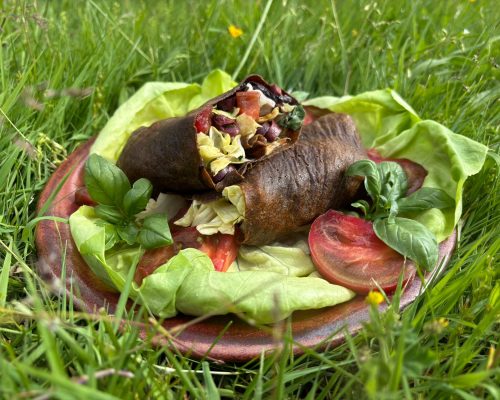
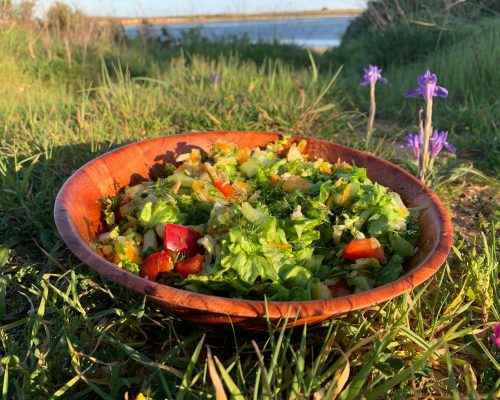
Diet: Over these 6 years, I gradually moved towards a diet that is exclusively organic, local, and homemade. I produce half of my food (vegetable garden, orchard, and chicken coop) and prepare all my meals. As a “good student,” I do not consume alcohol (nor any drugs), sodas, cold cuts, chocolate, or industrial food.
Lifestyle: Intensive triathlon practice, living in the countryside, no stress.
Physical health status: I wear glasses (myopia and astigmatism), I suffer from allergies to cat hair and pollen (getting stronger each year), I have increasingly severe and tiring colds (even in summer), skin problems (acne, cysts, and excessive sweating), and I suffer from sciatica that is also getting more intense each year.
Psychological health status: I suffer from an unidentified latent depressive state with a tendency towards outbursts of anger. I am very introverted and shy by nature, living closed off. Any form of spirituality is denied; only what is visible or measurable exists for me (a very Cartesian and materialistic approach).
From 2014 to 2018, beginning of dietary transition
Following a spontaneous fast (imposed by my body) that changed the course of my life, I modified my beliefs about food (paradigm shift). To learn more, read this article explaining why I changed my diet and took off my shoes.
Diet: Plant-based and raw (to learn more: read this article on the origin of living nutrion) about 80% with the desire to eat only living food but unable to put it into practice. Obsessive and recurring cravings for industrial food that I had not known before. Yo-yoing between fasting (or dietary restrictions) and binge eating. To learn more about the transition to living nutrition.
Lifestyle: Fasting (10 days a year), intermittent fasting, cold baths, yoga, meditation, and barefoot running.
Physical health status: Improvement in my vision (no longer need glasses), definitive end of sciatica, slight decrease in allergic episodes and colds, notable reduction in skin problems.
Achievement of a world first with the America Extrema expedition.
Psychological health status: The practice of hygienism brings me much pleasure and joy through the body, serving as an antidote to my depression. It also helps me cultivate calm, peace, and security within myself. Gradually, I dare to speak in public (lectures about my travels), and I open up to spirituality. It no longer seems possible to live as if the world of the invisible did not exist.


From 2018 to 2022, discovery of cleanses
Nutrition: Raw food and cleanses allow me to eat only plant-based and living foods, my goal. End of cravings for cooked foods and animal products. To learn more about the transition to living nutrition and my experience with cleanses.
attention liens bizarres
Lifestyle: Fasting (60 days a year cumulatively), intermittent fasting, cleanses (50 a year), liver cleanses, cold baths, yoga, meditation, barefoot running, and conscious breathing.
Physical health status: I occasionally go through healing crises (fevers, colds, and sore throats), while allergy symptoms decrease significantly. End of skin problems. Great physical shape, very quick recovery after sports.
Achievement of two other world firsts with the “The Fasting Walk” expedition and “The Footprint”.
idem
Psychological health status: I am interested in many new disciplines (shamanism, magnetism, tantra, personal development, permaculture, etc.) and I am increasingly comfortable speaking in public and asserting myself. I feel like a new person and no longer suffer from depression. I feel increasingly connected to the sensations of my body and my emotions. Cleanses help me both physically and psychologically to overcome difficult moments.
From 2022 to 2023, end of the dietary transition
Nutrition: Very comfortable with plant-based and living food, less and less raw food, most often consuming foods raw and, in general, consuming less and less fat.
Lifestyle: Fasting (60 days a year cumulatively), intermittent fasting, cleanses (40 a year), liver cleanses, cold baths, yoga, meditation, barefoot running, and conscious breathing.
Physical health status: Very good shape, end of allergies, stable but not perfect vision. Appearance of slight eczema (which does not go away even during fasting) and dental cavities (due to stopping dental hygiene after my beginnings in hygienism, I will soon write an article on this subject) related to emotional stress.
Psychological health status: Feeling of great connection with life, channeling of information, intense spiritual experiences. At the same time, this full reconnection to the living leads me to dive into the heart of my soul wounds to heal them. Moments of transformation that are difficult to experience. This time, the intense rhythm at which I cleanse (3-4 times a month) no longer helps me but, on the contrary, exacerbates the symptoms. I conclude that there comes a time, after a certain period, when forced detoxes (through cleanses) bring imbalances, just as detoxifying foods like garlic and onion are contraindicated in Ayurveda for yogis seeking a state of balance.
The time for assessment
After 10 years of intensive hygienist practice, I have resolved almost all of my health problems, enjoying great energy and quality of life. However, due to not being aware of the limits of the hygienist model, I have developed some health issues that I did not have before: cavities (see this article on dental hygiene) and eczema, both primarily linked to emotional imbalances. Awareness of these imbalances has been facilitated in my case by living nutrition and detoxes that have removed the barriers preventing me from fully feeling my emotions. Indeed, I believe that cooked food partially anesthetizes our emotions, which then accumulate in the body with toxins (fears associate with glues, and anger with acid crystals). To simplify, we can say that hygienism, among other things, cleans our filter for perceiving and feeling reality.
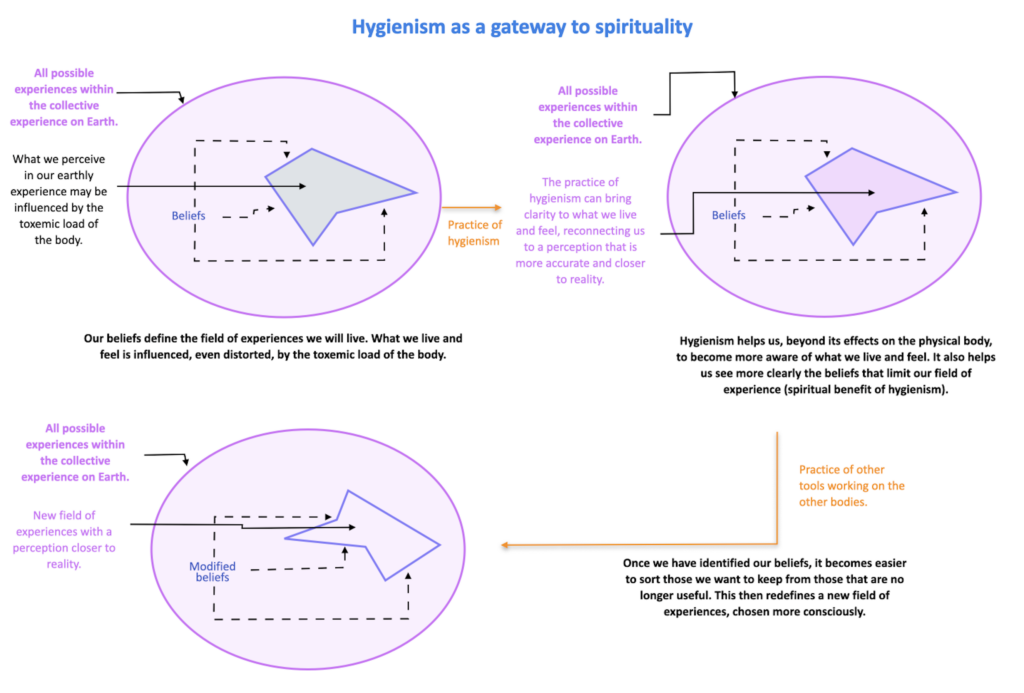
There comes a moment during the dietary and hygienist transition when the eliminatory organs have become sufficiently functional, the immune system strengthened, vitality greater, and moods sufficiently cleansed so that we can only use detox techniques (especially cleanses) occasionally, when the body truly demands it (in case of a functional crisis, for example). Otherwise, we force the body to do unnecessary work (the body knows how to function with toxins when they are below a certain threshold, and it is important to let it detoxify at its own pace) which causes an imbalance in the other bodies, particularly emotional.
According to my expertise, to know if one needs to intensify their hygienist practice (I am particularly thinking of plant-based and living food and cleanses as they are powerful tools for regeneration), it is very simple, there are two questions to ask oneself:
- Have I reached a dietary balance that suits me?
- Have I reached a health status that suits me?
If one answers “no” to even one of these questions, then one may potentially benefit from moving towards a more “hygienic” life, that is to say, with more raw plant food accompanied by detox techniques.
If this practice is not stable or does not yield results, it will likely be necessary to turn to one or more other complementary approaches that will work on the other bodies (mental, emotional, or energetic).
The limits of the hygienist model
The 10 years of hygienist experimentation detailed above have led me to believe in the following hypotheses.
- One cannot eliminate all the toxins accumulated since the fetal stage when one has several decades of conventional eating behind them. It is easy to convince oneself of this by looking at a tattoo. Indeed, the ink used does not disappear even after long fasts. Therefore, it is futile to bet everything on body detox and physiological nutrition to achieve full health.
- The body produces its own toxins (endogenous) that can pose problems, in situations of stress and repeated “negative” emotions, if they are produced in too great a number as they can potentially accumulate in the body and cause diseases. This is especially true if the moods are loaded (with exogenous toxins), the eliminatory organs are dysfunctional, and the immune system is weakened or vitality insufficient.
Even in the absence of exogenous toxins, diseases can develop
I am now convinced that health does not depend exclusively on the absence of exogenous toxins (those produced by the consumption of non-physiological foods and pollution), this is where the hygienist model (see axiom no. 2) shows its limits if we consider that the body has the capacity to poison itself (with endogenous toxins) despite good hygiene (focused on the body). Furthermore, there are molecules in the human body called Xiap and Diablo (to learn more: https://en.wikipedia.org/wiki/XIAP) that play a key role in apoptosis (the destruction) of cells, a vital mechanism that allows the body to select and destroy old, sick, dysfunctional, or damaged cells. When this mechanism is faulty, the risk of developing health disorders increases significantly, even in the absence of exogenous toxins.
Of course, an unfavorable terrain (related to inappropriate hygiene) can cause a disruption at the level of this mechanism. But given the important role that emotions play in the onset of diseases (see “The Great Dictionary of Diseases” by Jacques Martel, see the works of Dr. Hamer) and the revealing names of these two molecules (Xiap is the anagram of Peace and Diablo is the one who divides), I now believe in the following hypotheses:
- Diseases can manifest in the body even in the absence of exogenous toxins. For this, it is enough that the other bodies (mental, emotional, and energetic) are unbalanced, or that love and peace are no longer at the center of our lives. Hence the futility of betting everything on detox to improve health, even if, of course, it can reduce symptoms.
- Human beings are multidimensional and health consists of finding harmony between the physical, mental, emotional bodies and the other energetic bodies.
The hygienist perspective that considers toxins as the origin of diseases is therefore a relative and not absolute truth. On another level, one can consider that disease is the expression of an imbalance between the bodies.
Human beings are multidimensional and health consists of finding harmony between our different bodies
As psychotherapist Bénédicte Lhôte explains:
“The living is made of 7 elements:
- Lives
- Matter (earth)
- Organisms (living beings)
- Mentals (air)
- Affectives (water)
- Energies (fire)
- Spirits (soul)
Each element must be considered, nourished, cleaned, and maintained.
For matter, we must take care of nature.
For the physical body, there are hygienic practices.
For the mental, there is knowledge, culture.
For the affective, there is the management of feelings.
For energy, there is osteopathy, magnetizers, movement, breathing.
For the spirit, there is meditation, spirituality, and beliefs.”
When there are too strong imbalances between these different bodies, it manifests (somatization) in the body through diseases since it is the visible part of our being. To visualize this, one can imagine a wet sponge where the water contained represents toxins (emotional and physical, memories). When there are tensions/imbalances between the bodies, it’s as if we are wringing out the sponge: water comes out (toxins of all origins) and that is somatization, the crises of elimination. When the tensions/imbalances are not too strong, the water evaporates gently (natural physical, emotional detox, and memory detox).
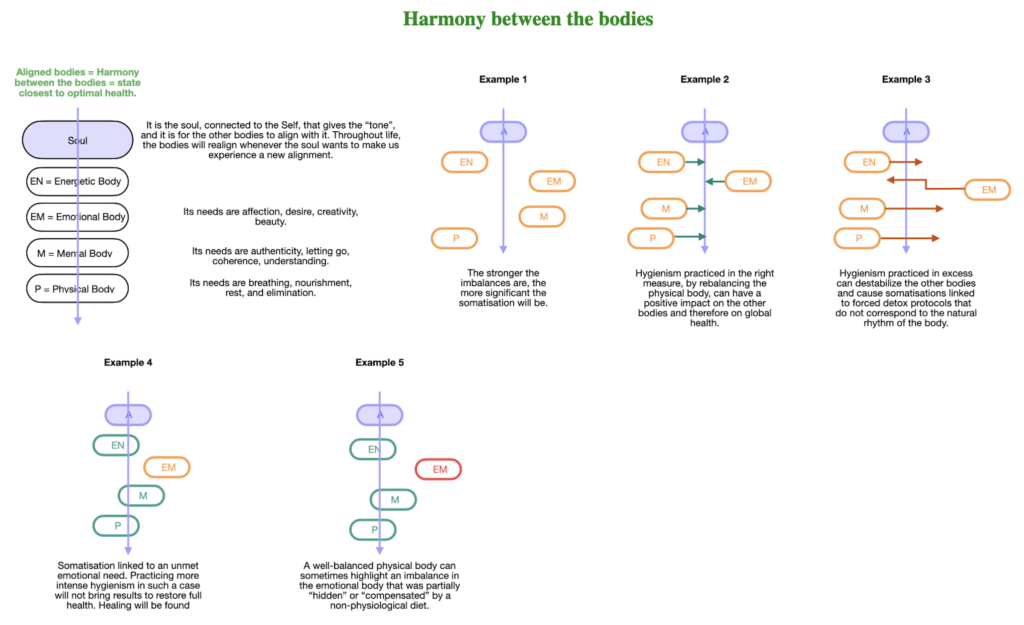
If the bodies are in harmony (which happens when one is on their life path), the physical body can therefore tolerate a much higher toxic load than if the bodies are unbalanced, and this, without somatizing. This diagram also allows for a plausible hypothesis to explain how homeopathy works, which, by simply importing information, will act on the subtle bodies and stop somatization without necessarily reducing toxicity. Similarly, it can also justify why the so-called “subtle” part of plants that we work with in aromatherapy has virtues at the bodily level.
Example: I noticed recently that my vision was noticeably declining and that my eyes were burning. Fasting and other detox methods (including eye cleanses) did not change my problem. I thought it was related to too long exposure in front of my computer screen (it takes time to gather all one’s thoughts and inform oneself…). In reality, I had emotions surfacing and I was unconsciously preventing myself from crying (like Ray Charles who became blind by not crying over his brother’s death). Letting the tears flow allowed me to regain a vision superior to what I had before. This is an emotional approach that can also be explained with toxicity: if too many acids accumulate in the eyes (which are also outlets) and the tears do not flow, then this acid can burn the nerve endings (as with hair, which results in hair loss).
In conclusion
Hygienism aims to take care of the physical body, which is the site of somatization, where imbalances between the bodies materialize as diseases, either through excess toxins present in the body or through dysfunctions caused by the body itself in the absence of exogenous toxins.
That is why hygienism alone cannot claim to cure all diseases and why it is futile to aim for the state (even theoretical) of optimal health without equally addressing the different bodies.
In hindsight, I now consider that hygienism is there to develop our sensitivity, to fully reconnect us to the living, to our feelings and emotions so that the true healing we came to experience in incarnating occurs: that of the wounds of our soul, along with the acquisition of certain knowledge and experiences. Healing our physical body wounds is not the priority for the life that flows through us, so the health that often results from the practice of hygienism is not a direct benefit, but a collateral one due to an expansion of our consciousness.
Taking care of one’s body with hygienism can, depending on configurations, bring balance or create imbalances (sometimes necessary) with the other bodies that life will require us to evolve until we find the harmony that is our own, which will need to be renewed at different times throughout our life.
Lightening one’s diet and detoxifying one’s body is a process that must take into account temperaments, the adaptive limits of the body, and each person’s life paths. That is why plant-based and living nutrition must be adapted individually. That said, I believe that many will benefit (on all levels) from introducing at least half of plant-based and living nutrition into their diet. It is the body and not the mind that will guide the body, after several years of transition, towards the balance that is most favorable to it. For some, as was my case, practicing hygienism radically was a gateway to reconnecting with something greater than myself and returning to the essentials that I had lost sight of: putting Love at the center of my life…
If our body is our vehicle as is often said, then hygienism would be somewhat like the toolbox of the garage. A vehicle is made to move (wherever life leads us) but its maintenance should not be an end in itself. What do we do with this well-maintained vehicle? This leads me to suggest: What if hygienism were just a simple pretext, or a healthy way, to give Love?