Introduction
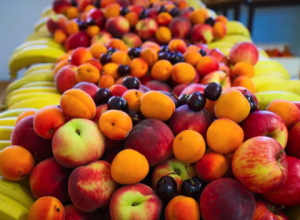
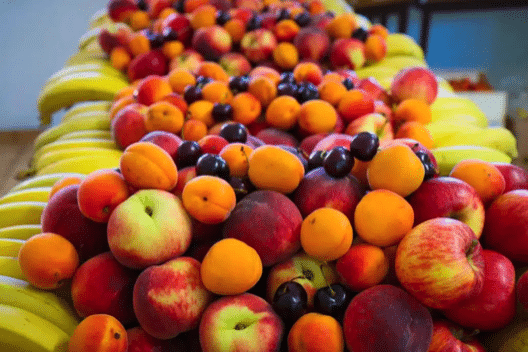
The cuisine of a frugivore is immediately recognizable by an abundant and colorful display of fruits showcased on the countertop rather than left to their fate in an isolated bowl or in the fridge’s vegetable drawer. Fruit is the staple food that is optimal for our primate constitution (see this article on the origins of Living Nutrition) but the conditioning that can distance us from it is manifold:
- “All that (in volume)?!”, “But isn’t that too much sugar with all those fruits?”
- “Are they organic?”
- “Fruits are too expensive!”
These mental obstacles to fruit consumption are regrettable because the word “fruit” comes from the Latin fructus which means “to enjoy.” This suggests a direct link between the permission we give ourselves to eat fruits and our ability to enjoy life. Moreover, in Greek mythology, it is said that Demeter, the goddess of fertility, carried a cornucopia filled with fruits and vegetables symbolizing the earth’s generosity and the prosperity it offered.
The purpose of this article is to share some good tips & tricks from a modern forager to achieve beautiful harvests in the jungle of supermarkets and thus feast on fruits and vegetables.
Note: To understand the harmlessness of fruit sugar, which has nothing to do with refined sugar, read these two articles on fresh fruit juices and on sugar in Living Nutrition.

Eating “well” before eating “organic, local, and seasonal”
For the “fruit hunt” to be fruitful, it is essential that the purchased foods are tasty enough (otherwise, one won’t want to eat them) and that they represent an accessible budget (otherwise, one won’t be able to buy enough). It is up to each individual to juggle these two parameters as best as possible.
If I have chosen to prioritize “good” over “organic,” it is partly because the flavor of a food is due to its unique combination of nutrients (minerals, antioxidants, vitamins, enzymes, and other phytoactive principles). And partly because cultivation on depleted soil with many chemical inputs will inevitably yield less nutritious foods that will, therefore, be bland. For these reasons, if a fruit or vegetable is good, it has grown under correct agricultural conditions. Our millions of taste buds and olfactory receptors can inform us about the nutritional quality of a food without needing laboratory analysis results (see this article on sensory nutrition). But we especially need to learn to recognize ripe fruits and, for others, to differentiate (by color, texture, and smell) those that can ripen at home from those that were harvested too early.
Note: I provide other reasons for this prevalence of good over “organic, local, and seasonal” in this article on organic, local, and seasonal foods.
We are a consumer society that suffocates under excess, and aided by supplement sellers and their many affiliates, we still fall into the fear of scarcity even though we have access to fruits and vegetables from around the world, all year round!… Moreover, our needs for micronutrients are generally poorly understood, and detected deficiencies are most often due to a lack of assimilation directly linked to soil contamination. This is why blood tests are generally better after a fast than before, even though nothing has been consumed in the meantime. Read this article on how to address deficiencies to learn more about this topic.


Investing in Living Nutrition
The food I select in stores to meet my needs in quantity and quality represents a budget of between 15 and 20 euros per day for a daily caloric intake of between 2500 and 3000 Kcal. By being less active, one can manage with 15 euros per day, which, counting some small extras, results in an average monthly expenditure of 500 euros on fruits and vegetables. Certainly, it is more expensive than pasta and Coca-Cola, but I save on bars and restaurants where I hardly ever go.
Furthermore, this amount should be put into perspective because the European Union injects four times more subsidies into animal husbandry than into plant agriculture (see this article from The Guardian). Thus, animal products are subsidized by Europe (through our taxes) and are sold at least twice as cheaply as they would normally cost, not to mention the real costs (environmental, health, social). Read this article on the impact of veganism on the environment to learn more about this topic and understand that fruits that come by air are absolutely not the cause of our planet’s environmental problems. From this, there is a key principle to remember if one wants to eat physiologically: We are made to live in the tropics (the cradle of humanity), so either we go towards the fruits, or they come to us.
Another consideration that helps to put the “fruit” budget into perspective is to link the consumption of non-physiological food with the consumption of medications encouraged by current policy, through social security reimbursements and the support of doctors. Canadian doctor Gabor Maté explains in his videos and in his wonderful film “The Wisdom of Trauma” that medications functionally act like corticosteroids that stifle inflammation, calm pain or stress, and short-circuit the body’s normal reaction without addressing the root cause of the disorder (discomfort and lifestyle hygiene). The consumption of medications numbs feelings and contributes to conformity, consumer society, and the futile pursuit of distractions at the expense of awakening consciousness.
This digression is to give value to these 500 euros per month, which represent an investment for a flourishing health, joy in the heart, and energy to spare. This could also be quantified: better performance at work, fewer sick days, and fewer medications. And above all, in return, better guidance with one’s soul (see this article on the link between Living Nutrition and vibrational frequency) that gradually allows one to break free from consumer society, put an end to repeating life scenarios, and bring something new into one’s life.

How much fruit and vegetables?
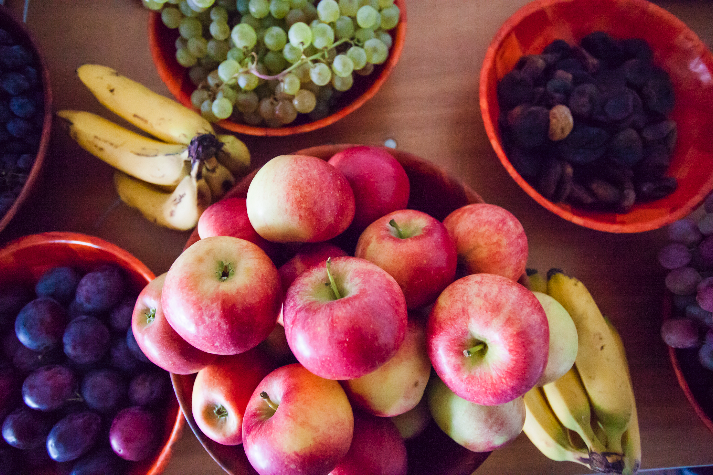
For a person who sustains themselves on raw fruits and vegetables, one should count about 4 kilos of sweet fruits and 1.5 kilos of sweet fruits/vegetables per day. Since these foods contain between 80 and 95% water, it is easy to understand why one does not feel thirsty with this type of diet and why pure water is so unappetizing (except when one is dehydrated).
In my van, where there is little space for storage and no fridge, I go shopping every 5 days or so. And when I was sedentary and shopping for 4 raw foodists, I would buy the equivalent of two full carts, which corresponds to the average volume for 10 days of food. Sweet and soft fruits are stored in boxes/crates that are placed on shelves (in the sun or in the shade) at room temperature so they continue to ripen, unless one wishes to delay their ripening for stock management. As for leafy and root vegetables, they are stored in the fridge. Every day, I check on the fruits (as if to say hello) and gather the ripest fruits in a large bowl to be consumed first.
Where to buy fruits and vegetables?
Taking into account the principle of “eating well before eating organic” and a budget of 500 euros per month, I have naturally been led to select products from 4 types of stores:
- Grand Frais (or if not, Provenc’halles and Mangeons Frais), my number 1 reference for fruits. The store I would choose if I had to pick just one because it has the essentials and it’s good, especially for fruits where one is rarely disappointed and whose taste is superior to organic for exotic fruits.
- Organic stores (with a preference for Satoriz) where I primarily source my vegetables because they are better here than in conventional agriculture for often minor price differences. But their supply is not constant and the choice is more limited, so it’s preferable to have alternatives elsewhere.
- Aldi and Lidl where one can find fruits and vegetables at unbeatable prices, and some of which are very good.
- Online shops like CrowdFraming (the innovative principle of adopting a tree and receiving its harvest), Jurassic Fruit, Fruistock or Biovie. All alternatives to receive organic fruits of superior quality to those found in stores. And for rarer products, there is:
- Naturitas for sea water
- Biocéan for dried seaweed
- Biovie for fresh seaweed, sprouted seeds, and fresh coconuts
- Koro for superfoods
Here is a list of products I commonly consume from each of the aforementioned stores:
Grand Frais / Provenc’Halles / Mangeons Frais | Organic stores | Aldi and Lidl | Online shops |
Seasonal fruits, plantain bananas, boat mangos, papayas, packaged pineapples, oranges, fresh coconuts, Medjoul and Mazafati dates, dried figs, cherry tomatoes, untreated lemons, bell peppers, cucumbers, squashes, zucchinis, celery stalks, spinach, arugula, aromatic herbs, sweet corn, avocados, and mushrooms. | Apples, grapes, oranges, bananas, salads, bell peppers, beef heart tomatoes (locally sourced), carrots, sweet potatoes, cabbages, fennels, celery stalks, radishes, squashes, zucchinis, dates and dried figs, avocados, olives, raw cacao, nuts, turmeric, ginger, mushrooms, spices, oils and honeys*. | Juicing oranges, watermelons, avocados, green/yellow/cantaloupe melons, blueberries, pears, flat peaches, organic bananas, organic lemons, organic cucumbers, and multicolored cherry tomatoes (untreated). | Sea water, sprouted seeds, and seaweed. |
Notes:
– For oils and honeys, it is important to choose organic because, as they do not contain fibers, agricultural inputs enter the bloodstream directly. Read this article on organic to learn more about this topic.
– By eating to your fill from this shopping list (which can certainly be supplemented), the body will find everything it needs to function optimally, have energy, build itself, and regenerate.
Conclusion
You are now well-informed to venture into the urban jungle to pick good fruits and vegetables. All that’s left is to prepare and enjoy delicious fruit meals&vegetable meals and thus fully enjoy the benefits of plant-based and living nutrition.