Translation note: this video is currently in French, but you can activate YouTube’s auto-generated subtitles in English while we work on providing a dedicated English version.
Introduction
The hour following waking is precious as it sets the tone for the rest of the day. That’s why it should be dedicated to addressing our true needs to feel good. This is the role of the morning routine, preferably practiced while fasting, which aims to:
- Cleanse the body and mind of tensions and residual negativity.
- Oxygenate the cells and improve the circulation of bodily fluids.
- Develop flexibility, increase joint mobility, and enhance vitality.
- Bring mental clarity and good mood.
Over the months, the morning routine establishes a solid anchor that contributes to cultivating a calm and inner security independent of external circumstances. It engrains new habits to increase energy and creativity without resorting to stimulants like coffee. Furthermore, it becomes a pivot around which an expanding space of awareness opens up, allowing for true inner transformation.
Body Hygiene
1. Regularly test your saliva and urine with a pH meter
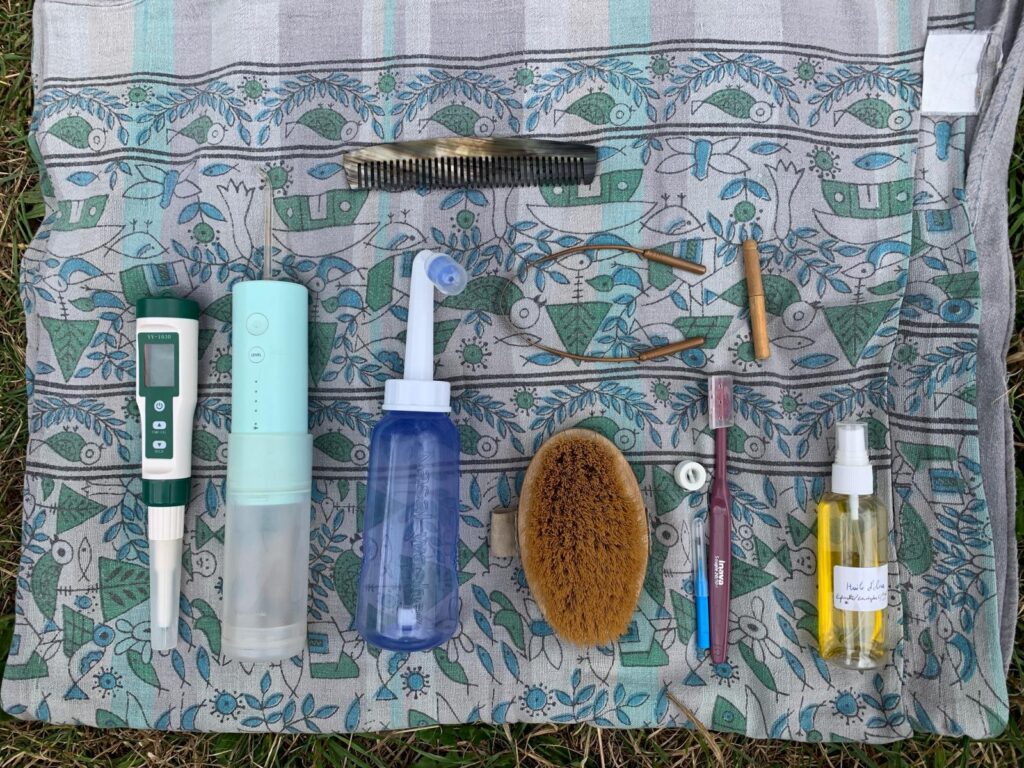
Upon waking, spit into a small cap and also collect the first urine of the morning. Test these two bodily fluids with a pH meter or litmus paper (less precise). If either of these two bodily fluids has a pH < 6.5, it means your body is in acidosis and dietary and lifestyle changes need to be implemented to alkalinize the body. Urine and saliva should be tested regularly as they evolve based on living conditions (especially dietary).
2. Dry brushing of the skin
It allows you to:
- Promote lymphatic and blood circulation.
- Remove dead skin and impurities without using water or soap.
- Open the pores (sweat and sebaceous glands) so that the skin (the largest emunctory of the body) can eliminate toxins more easily.
Depending on your skin’s sensitivity, choose a firm or soft brush (online or in health stores) and brush upwards along the lymphatic channels to the lymph nodes. The precise movements to follow are detailed in this video.
Translation note: this video is currently in French, but you can activate YouTube’s auto-generated subtitles in English while we work on providing a dedicated English version.
3. Oral hygiene
Good dental hygiene consists of removing all food deposits stuck in the mouth and cleaning the interdental areas where saliva (a natural and sufficient antiseptic) circulates little. To best achieve this cleaning, it is advisable to use (in this order) a water flosser, a quality soft-bristled toothbrush (Inava is a very good brand), interdental brushes to clean small spaces, and finally, dental floss (without additives like fluoride) to clean very small spaces. The use of toothpaste is not recommended unless it is homemade with natural ingredients like clay, activated charcoal, or baking soda. To finish, you can perform a mouthwash with seawater to alkalinize the oral environment and perhaps even remineralize the teeth. Read this article to learn more about dental hygiene.
4. Nasal irrigation
Good nasal breathing is a key element for properly oxygenating the brain, cleansing the lungs, ensuring good blood circulation, and regulating the nervous system. Nasal irrigation cleans the sinuses by stimulating mucus production that expels toxins stuck to the mucosa. To do this, the simplest method is to obtain a neti pot (online or at the pharmacy) that you will fill with seawater (pure or isotonic) or, if not available, with fresh water mixed with unrefined sea salt, diluted to 10 g/L (about 2 teaspoons). Then, hold your head upright, gently insert the tip of the neti pot into one nostril, pump the water with the button provided until it comes out the other nostril. Repeat the operation with the other nostril. Wait about ten seconds and then blow your nose.
5. Cleaning the ear canal
This involves cleaning excess earwax using a ear cleaner or a cotton swab previously moistened with saliva.
6. Dry brushing of the scalp
With a brush or comb (wood, plastic, or horn), brush your scalp from the roots to the tips for about 1 minute to remove dead skin and dust while distributing sebum along the length of the hair. Brush with your head upright and then with your head down for optimal sebum distribution. This is a practice known as no poo. To learn more, read this article. (Translation note: this link leads to a website in French. To read it in English or another language, simply copy the URL and paste it into Google Translate https://translate.google.com/?sl=fr&tl=it&op=translate)
7. Cold shower
It complements the dry brushing of the skin and scalp by removing residual impurities, boosting blood circulation, and firming the skin and hair. Moreover, it favorably stimulates the sympathetic nervous system, giving you energy (much better than coffee) while removing parasitic emotions. Read this article to learn more about the benefits of cold exposure.
During this shower, any use of soap or shampoo (organic or not) is undesirable for two reasons:
- on one hand, everything we put on our skin should be edible because some of the substances eventually enter the body through the pores.
- on the other hand, the use of detergents (organic or not) removes the protective lipid film (made of sebum) that covers our skin and hair. Removing it with a detergent (gentle or not) weakens the skin and prompts the body to produce more sebum, which can lead to oily skin or hair problems.
For these reasons, the use of soap or shampoo should be limited to once a week. One of the most common strategies is to gradually reduce their use so that eventually, you can do without them completely. Also, know that a healthy diet will eventually eliminate unpleasant body odors, making the use of soaps and deodorants unnecessary, which can be replaced by essential oils (like palmarosa essential oil). If despite stopping detergents and improving your diet, your skin or scalp remains “oily,” it may be necessary to reduce lipid consumption. To learn more, read this article on our lipid needs.
On the other hand, for those with dry or damaged skin, it is beneficial to use a massage oil, such as those based on sesame or olive oil, possibly mixed with essential oils. The oil should be applied to still damp skin for easy spreading while hydrating the skin.
Conscious Breathing
What we need upon waking is not to eat or drink coffee but to breathe enough fresh air. Air is our primary food (20 kg per day) and has the power to bring us a lot of energy if we breathe properly.
Conscious breathing allows us to:
- Re-educate the breath (as it is generally dysfunctional).
- Vitalize by increasing oxygenation to the cells.
- Promote blood circulation through hypoxia, which induces vasodilation.
- Regulate the nervous system and provide a sense of fullness.
There are a myriad of breathing techniques; everyone should use those that suit them, knowing that it is preferable to choose ones that include phases of apnea (with hypoxia) as they have very interesting benefits such as the production of red blood cells. To learn more about this, read the article on the law of hormesis.
Personally, I like the combination of alternating one day with a hyperoxygenation session and another with a hypercapnia session.
Hyperoxygenation Breathing:
Example protocol: Lying on your back, perform 30 powerful breaths (inhaling through the nose: belly + chest, exhaling through a relaxed mouth, sudden and without forcing) followed by an apnea, empty lungs (or full lungs), held until the suffocation reflex. Then, take a deep breath (or exhale) followed by a short apnea of about 20 seconds. During this time, focus your attention on the sensation of warmth that arises in certain areas and diffuse it throughout the body through thought. Perform several series (at least 3).
Hypercapnia Breathing:
Example protocol: First, take three complete and deep breaths followed by an apnea with empty lungs (without forcing the exhale) for as long as possible. Then, take a deep breath followed by 15 seconds of apnea with full lungs, before emptying your lungs (without forcing the exhale) again and continuing with an apnea with empty lungs for as long as possible. Then resume slow and controlled nasal breathing for 2-3 minutes. Repeat at least 3 times.
Notes:
- Breathing exercises can be performed before personal hygiene.
- Click here to access conscious breathing audios on my YouTube channel.
Translation note: this video is currently in French, but you can activate YouTube’s auto-generated subtitles in English while we work on providing a dedicated English version.
Mouvement
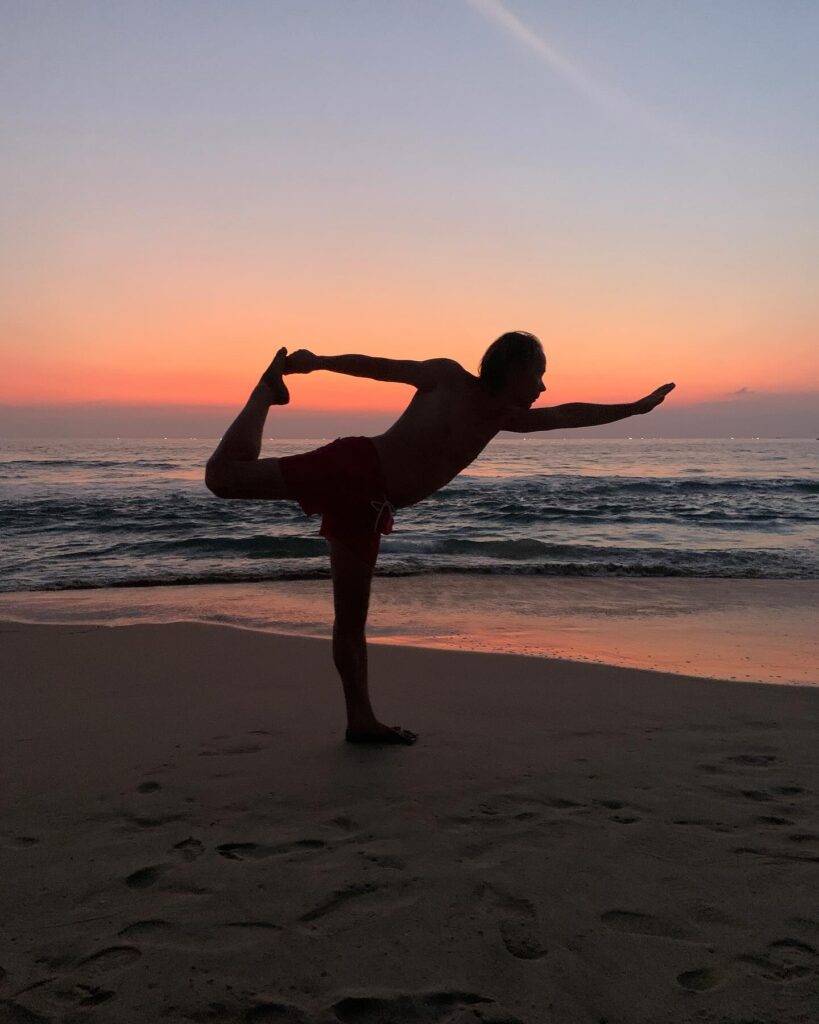
In this 3rd phase of the routine, the goal is to regain greater mobility and fluidity in movements. To achieve this, it is ideal to perform a sequence that mobilizes flexibility, joint mobility, muscle strengthening, and simultaneously regulates the endocrine, cardiovascular, and nervous systems. This completeness is generally offered by any good yoga sequence. Read this article on yoga to learn more.
You can also create your own custom routine inspired by yoga, Tibetan rites, animal flow, etc., and from certain movement professionals (to choose from social media) like, for example, Roye Gold. Personally, I like to alternate a Hatha Yoga session with a medley of movements of my own design.
Meditation
Meditation has the dual objective of developing the concentration of the mind and purifying it. According to yogic tradition, suffering originates from our identification with the body, thoughts, and emotions. To free oneself from suffering, there is only one path: that of awakening. It consists of rediscovering one’s true essence by developing within oneself that space of consciousness that feels through the 5 senses but does not identify with them. There are different methods of meditation to achieve this; personally, after 10 years of wandering in this field, I ended up choosing Vipassana meditation which is reputed to be closest to the teachings of the Buddha.
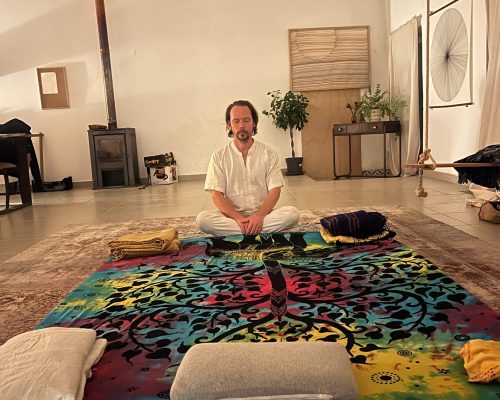
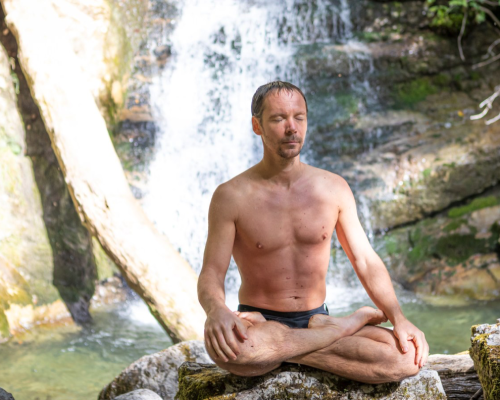
If you are a beginner, you can start with Anapana meditation which is taught as a prelude during Vipassana retreats. It simply consists of sitting cross-legged with a straight back and observing the breath and bodily sensations around the nose.
You can conclude this meditation with gratitude towards life, the benefits of this routine, and this new day on Earth that begins.
Conclusion
When performed in full, this routine will take at least 1 hour and 30 minutes of your time. This is an investment in taking care of yourself and moving, step by step, towards a better quality of life. For the routine to be anchored and for a transformation to occur, it is important to perform it every day (hence the name routine!), even if it is truncated. It is also important to vary the practice so that it remains lively, evolving, and stimulates your adaptive capacities.
Finally, it is up to you to ritualize this moment (for example, by lighting a candle, with incense, etc.) where you have an appointment with yourself. You know that afterwards your day is won no matter what happens because you have given yourself a precious time of listening and presence.
Now it’s your turn to play and honor your next appointment tomorrow morning!