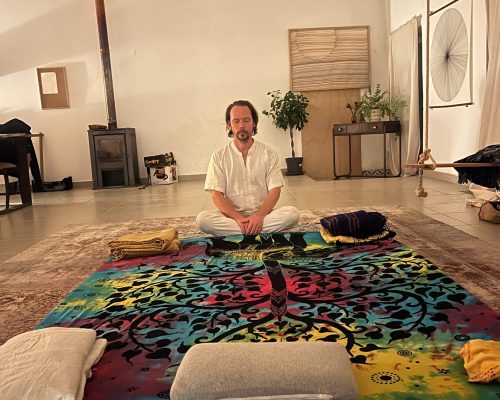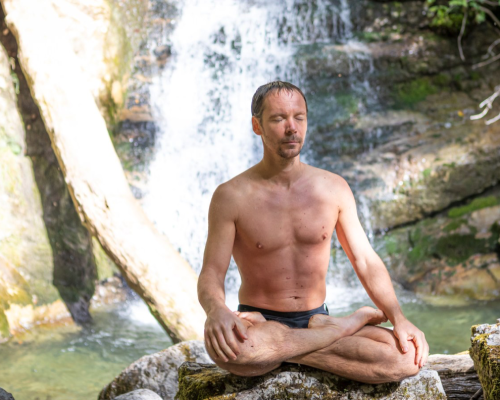
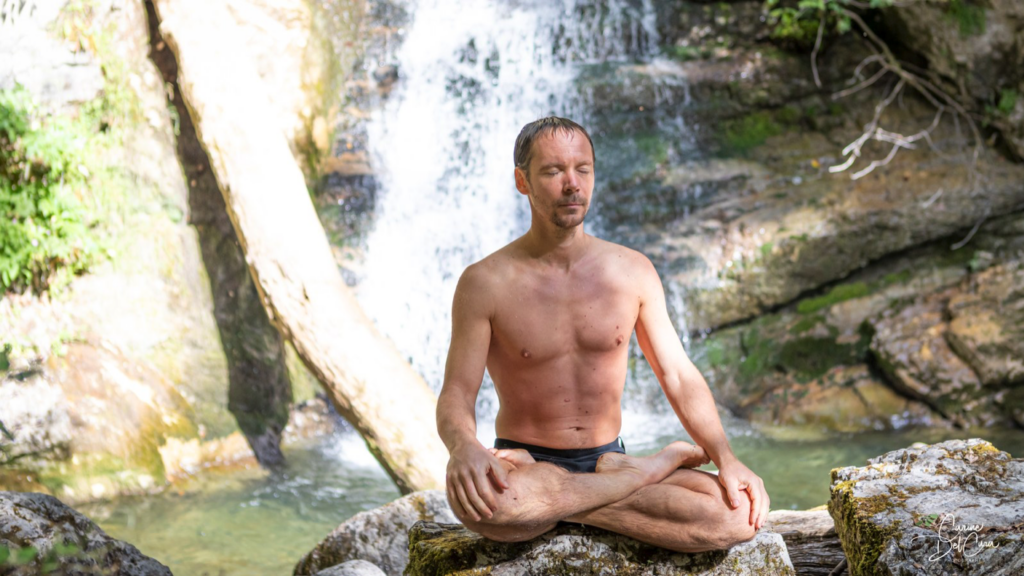
Why do I practice Vipassana meditation for two hours a day?
Vipassana, a Sanskrit word meaning “to see things as they really are,” is a meditative practice based on continuously observing sensations in the body, from head to toe and toe to head.
It does not use mantras or visualization, as these techniques can create pleasant states that distract from the direct observation of what is actually present within oneself.
Its dual purpose is to:
- develop a keen awareness of bodily sensations, providing direct access to inner reality;
- cultivate equanimity in order to transcend the conditioning of the mind and connect with a broader dimension of being.
Without body awareness, we live in ignorance or denial of what we are experiencing.
Without equanimity, we replay the same life scenarios.
This meditation, which is said to have been transmitted by the Buddha 2,500 years ago, is practiced for at least 1 hour in the morning and 1 hour in the evening. This regularity is the foundation for profoundly transforming the way we function and returning to the present moment.
What Vipassana brings me on a daily basis:
- less mental distraction, more presence
- deep calming of the nervous system
- greater acceptance of what is
- reduced inner resistance
- a freer relationship with desires and aversions
- a direct understanding of impermanence
- new clarity about the influence of the mind on the body
- heightened states of consciousness, without resorting to substances
- a feeling of inner abundance
- a more authentic quality of presence in my relationships
Some keys to integrating Vipassana into your life:
- Listen to the parts of yourself that resist and negotiate with them rather than fighting them.
- Understand that meditating is not a waste of time: it’s like consulting your map and compass before setting out on a walk.
- Recognize that the real waste of time is living trapped in repetitive mental patterns with all the disadvantages that this entails.
To go further
Read this full article on Vipassana meditation.