“It is only when one understands that all external things, all mental constructions, all material efforts are vain, useless, if they are not entirely dedicated to this Light and this Force from above, to this truth that tries to express itself, that one is ready for decisive progress. When one opens to the spirit within oneself, it gives you a first taste of this higher life that alone is worth living, then comes the will to rise towards that, the hope of reaching it, the certainty that it is possible, and finally the strength to make the necessary effort and the resolution to go all the way.”
Mirra Alfassa alias “The Mother”, founder of Auroville in India
Introduction
Suffering is a malady so universally spread that its origin, when not seen as a fatality, is obscure. Curious by nature and wanting to tackle my own suffering head-on, I have consulted, over the last 10 years, several therapists, mentors, mediums, clairvoyants, astrologers, numerologists, shamans, and participated in multiple personal development workshops, tantra, disarmament, shamanic ceremonies, and read about a hundred books on the psychological sphere. Until now, I have rarely addressed my experiences in this field (which I study at least as much as hygiene) because I consider it is not my specialty.
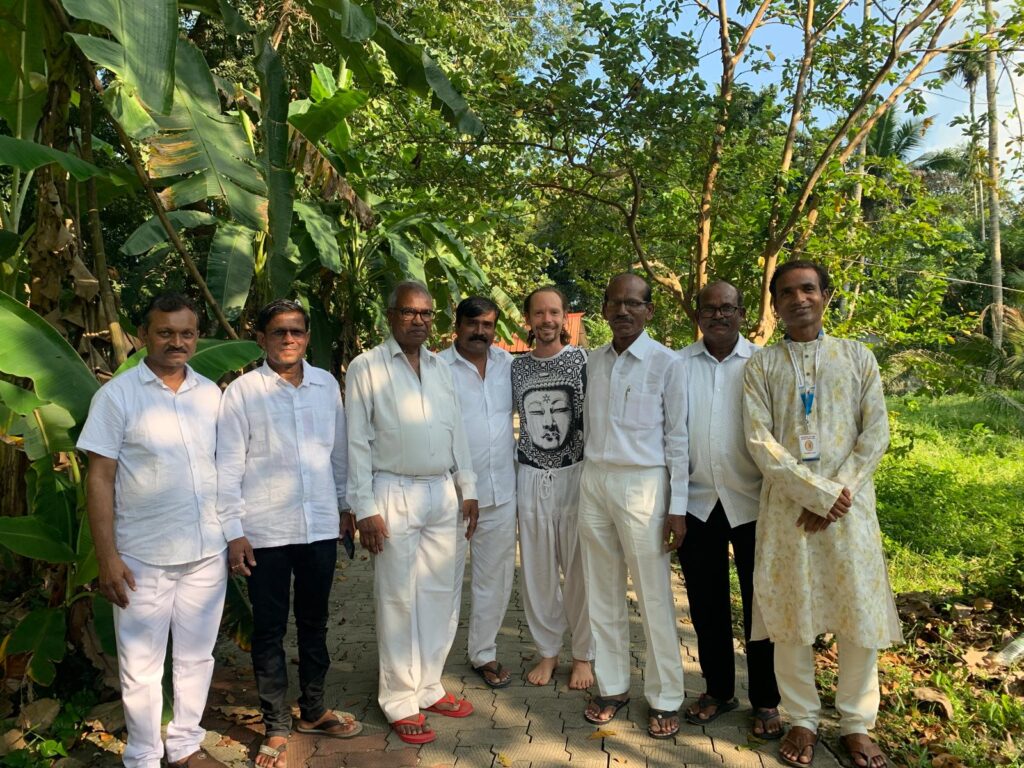
And then, in December 2024, in India, I participated in my first Vipassana retreat and there, I knew I had found the teaching I had been searching for over 10 years, one that goes to the root causes of suffering while purifying the mind. A big surprise awaited me because the principles at the heart of this teaching, originally transmitted by the Buddha, wonderfully complement the teaching of Irène Grosjean which aims to purify the body. I share in this article, in my own words, what I heard, retained, and understood from this Vipassana retreat.
Definitions and prerequisites
In this article, the term “spirit” encompasses the concepts of “mind” and “consciousness”, it refers to all the facts or phenomena produced by the psychic and cerebral functioning of a human being as well as their results (emotions, feelings, states of mind, desires, or even the psychology of the individual).
The mind (that is to say, the intellectual functions, thought, and reasoning) is a mechanism for interpreting reality so that the individual can position themselves, adapt, defend themselves, decide, or anticipate certain situations.
The Self or Ego consists of:
- The matter of which the physical body is made.
- Mental energies related to what one thinks, feels, reacts, and recognizes.
Total awakening is a state free of suffering where one no longer identifies with the Self, meaning that one no longer identifies with their thoughts, emotions, and sensations. There would be 4 progressive stages of awakening.
The human user manual
A human being consists of a spirit and a body that are intertwined, like yin and yang. One influences the other and vice versa. Every thought has the power to create pleasant or unpleasant sensations in the body.
For example, emotions (from the Latin movere which means “to shake”) that we feel arise from the meeting point between the body and the spirit. They are the result of the mind’s interpretation of a factual event.
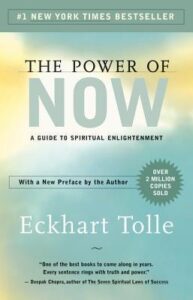
As Eckhart Tolle writes in “The Power of Now”: Emotions relate to the loss of awareness of the spiritual nature of who we truly are. Love, peace, and joy are not emotions, they constitute our baseline state when we are equanimous in the present moment, without identification with the Self.
All negativity (fear, anger, aversion, etc.) leads to a change in breathing and a modification of sensations in the body due to biochemical reactions (hormones). Hence the importance of purifying the mind, otherwise it can make us live hell on earth.
We have 6 senses that create our reality: sight, touch, smell, taste, hearing, and the sixth, thought. The objects (in the broad sense) that come into contact with the body create sensations through the 6 sensory doors born from the assembly between the spirit and matter. The mind catalogs pleasant (and then creates a desire) or unpleasant (and then creates an aversion) any object that comes into contact with the body and creates sensations.

Natural laws versus false beliefs
One of the fundamental laws of nature is the law of impermanence: all physical and mental phenomena appear and then disappear over time, they do not have an independent existence (the non-self).
If one identifies with their Self (which is the case unless one is awakened), we become slaves to our 6 senses and the impermanent sensations they generate. We then create attachments (desires) and aversions, which are strategies of the mind to be happy and protect itself. Whereas in reality, by creating desires and aversions, we attract situations where we will suffer from lack and experience what we fear.
The previous principle is another well-known natural law called the law of attraction, which could be summarized in these terms: “We are united to what we do not want. We are separated from what we want.” Another principle to know: the more we create desires and aversions, the more they multiply, like trees that bear many fruits giving rise to many trees. So it becomes vital at some point to break out of this vicious circle.
We have the belief that to protect ourselves from the outside world and meet our needs, we need to think about our recurring problems and develop strategies. That is why we let our mind be the master of the house instead of being its servant. Alas, this is vain because thought is linked to the past and cannot provide solutions to problems it has itself created. As Albert Einstein said:“ You cannot solve a problem with the same mindset that created it.”
The mind ultimately creates more problems than it solves: the biased interpretations it induces and the control it imposes lead to a deceptive relationship with oneself, to relational problems, and to a loss of self-confidence.
We also have the false belief that we can manipulate reality by being in negativity (resistance) to obtain what we want. It is this underlying mechanism that, for example, makes us react with anger. The reality is quite different: if we refrain from reacting to a given situation by cutting short our old conditioned reflexes and remain an equanimous observer (without attachment or aversion) and not identified with the sensations that unfold within us, then we break the vicious circle of our repetitive patterns. We thus allow the intelligence of life the possibility to bring us something new, which is what Eckhart Tolle calls the power of the present moment. Otherwise, we remain prisoners of the past, or the known as Krishnamurti said.
The key to understanding is to consider that we do not have to worry about our needs for life to respond to them. The simple fact of being aware is enough. A natural law that is found stated in the gospels in this formulation:”That is why I tell you: do not worry about what you will eat to live, nor about what you will wear for your body. Is not life more than food, and the body more than clothing? Observe the birds of the air: they do not sow or reap, nor gather into barns. And your heavenly Father feeds them. Are you not of more value than they?” Matthew 6:25-34 NBS. In my opinion, the art of living consists of becoming an equanimous observer of existence as if it were a film at the cinema. This does not prevent one from laughing, crying, and following their impulses, but, deep down, one never loses sight that this is a game, a dance of the living in which our soul has consciously taken part.
We also have the belief that misfortune buys what we want, which unconsciously gives us reasons to victimize ourselves with ruminations. The good strategy is rather to become master of the present moment, as it is from there that the future begins.
The origin of suffering
What we call ignorance is not knowing the natural laws mentioned above, or knowing them intellectually only without living them as a reality. It is ignorance that is at the root of suffering, a suffering that always comes from within, for outside there are only objects related to the senses. And the stronger the attachment and aversion, the stronger the suffering.
The origin of suffering thus comes from the existence of our desires (or attachments) and our aversions that make us slaves to our senses and involve an identification with the Self. The identification with the Self as well as with the sphere that revolves around it (made up of “my”, “mine”, “my”) is a major source of suffering since this Self is impermanent and each day brings us a little closer to old age and death. What we truly are, our spiritual essence, is permanent and constitutes our true nature.
Our mind has become deficient, polluted by attachment, aversion, anger, false beliefs, fears, negativity, etc., and often it gets lost in a subjective past or an imaginary future made up of projections. Skeptics or (too) rational people might wonder how one can live and thrive without mental chatter and without desire. In reality, it is when we have no more expectations (neither desires nor aversions) and are simply satisfied by being connected to the present moment (the true source of love, peace, and joy) that we can be truly active (we waste a lot of time and energy living in the past or the future) and creative thanks to the developments of the connection with our intuition, our soul, and with the intelligence of life.
The essential foundations of a healthy and happy life
According to the teachings common to all religions, the foundations of a healthy life are established according to a code of morality based on the following 5 precepts that I have reformulated in my own way:
- Do not kill and consider all forms of life.
- Do not steal and refrain from taking what is not given.
- Do not lie and have impeccable speech.
- Have a healthy and respectful sexuality.
- Refrain from consuming intoxicants (drugs, alcohol, porn, and any other addiction).
The fundamental idea to remember behind these 5 precepts, which can be subject to interpretation, is to cultivate a mental clarity, free from guilt and compulsion, that is oriented towards compassion. The goal is to promote harmony and peace through our conduct knowing that it is the true intention that prevails over our words and actions.
Without this morality, it is not possible to learn to control the mind and even less to purify it. Indeed, going against these 5 precepts generates impurities at the mental level, those very ones we would like to lighten.
According to the teachings of the Buddha, the three steps of the art of living (the Dhamma) to free oneself from suffering are:
- Morality (see above).
- Mastery of the mind.
- Purification of the mind and the development of wisdom.
To the universal ills of humanity (anger, fears, desires, aversions, negativity, and other mental poisons), the remedies must be universal. Addressing the cause of the causes of all suffering was the Buddha’s objective when he developed Vipassana, a meditation technique non-sectarian and universal that employs no visualization, prayer or invocation, nor any mantra, dogma, rite or ritual.
What is Vipassana?
Vipassana is one of the oldest meditation techniques in India. Long lost to humanity, it was rediscovered over 2500 years ago by Gautama the Buddha. The word Vipassana means seeing things as they really are. It is a process of self-purification through self-observation. One begins by observing the natural breath to concentrate the mind. With sharpened awareness, one proceeds to observe the changing nature of the body and mind, and experiences the universal truths of impermanence, suffering, and the non-existence of a Self.
Vipassana is a science of matter and mind aimed at developing awareness, wisdom, and equanimity in order to free oneself from suffering.
How to purify the mind?
The toxins of the mind, which are the source of our suffering, are called Sankharas in Pali (the ancient religious language of South India and Sri Lanka). A term that means “volitional activities,” “conditioned things,” and “mental imprints and formations,” concepts that refer to desires and aversions, fruits of mental activity, that we have within us or that we generate.
The antidote to suffering consists of developing perfect equanimity in the face of desires and aversion, in the face of bodily sensations. When one ceases, through equanimity, to produce sankharas of desire or sankharas of aversion, then, naturally, the old sankharas rise to the surface.
During a Vipassana retreat (10 days in silence meditating 10 hours a day), this mechanism of purification of the mind is facilitated and made conscious through a particular meditation called Adhitthana (a term meaning strong determination) where one is required to meditate on the sensations of the body while remaining perfectly still for an hour.
One then acquires one’s own wisdom that comes from one’s own experience and observations of the interactions between the senses, the mind, and the body. Wisdom is realizing that all these sensations coming through the 6 doors, which provoke attachments and aversions, appear and then disappear (impermanence) and that they have no inherent existence. This practice aims to make us autonomous, to take refuge in oneself and thus become one’s own master.
The symptoms of mind detox
When one meditates sitting still, unpleasant sensations quickly arise: itching, pain, tension, tingling. These are old sankharas (impurities of the mind) that rise up, and if one remains perfectly still, equanimous, and does not react, then these old sankharas are eliminated.
One is surprised to see how difficult it is to remain still for an hour. Experience shows that it is not a question of flexibility; these difficulties reflect our internal tensions and our lack of mastery of the mind. For proof, animals can remain still for long periods without issue. Moreover, when we identify with the Self, a physical pain becomes a mental pain. Experience shows that a pain decreases by 90% when we fully accept it.
Not reacting to sensations allows us to reverse the process of suffering and to release sankharas. Hence the crucial importance of being aware of sensations if we do not want to react to them. In the long run, the development of equanimity allows us to observe physical pain in a completely neutral way, and even to love that pain.
Pleasant sensations can also arise. If we attach to them, we then create a new sankhara of desire. The idea of Vipassana meditation is not to create pleasant sensations, special states, or anything else but to observe what is truly there while remaining in equanimity to train ourselves to be so in all circumstances, especially outside of meditation times.
Reaching the deep level of the mind
The superficial part of the mind, or consciousness, is connected to the 6 senses, but when we work with bodily sensations, we connect to the deepest part of the mind, which then awakens fully.
Therapies that are approached at an intellectual and emotional level but do not use bodily sensations are therefore unable to reach the deep layers of the mind. They are, therefore, incapable of effecting a profound transformation of the being by going to the cause of the causes of suffering. In reality, when we divert our attention from our negativity, which many so-called emotional management techniques propose, we repress it more deeply.
The parallel between hygiene and the teachings of Vipassana
What amazed me during this Vipassana retreat was to see the similarities and the identical logic between the purification of the mind (vipassana) and that of the body (hygiene). I leave you to discover this astonishing parallel:
Vipassana as taught by S.N. Goenka | Hygiene as taught by Irène Grosjean | |
Purpose of purification | Mind | Body |
Name given to impurities | Sankhara | Toxin |
Objective of the method | Get to the root causes of suffering | Get to the root causes of illness |
Nature of these impurities | Desires and aversions | Acids and glues |
Natural means of purification | Meditation | Fasting |
Daily habit to allow purification | Equanimity | Plant-based and Living Nutrition |
Technique to unblock impurities | ||
Culture at the origin of the teachings | Eastern | Western |
Awakened beings who taught it | Buddha | Jesus |
Reference texts | The Lotus Sutra | The Essene Gospel of Peace |
Interactions | Purifying the mind brings better health | Purifying the body brings greater awareness |
Finality | Become your own master to achieve full awakening | Become your own doctor to achieve optimal health |
Allies on the path | Shamanic plants | Medicinal plants |
The correspondences do not stop there; here are other similarities between the two purification methods:
- A period of well-being is always followed by a detox of sankharas/toxins that rise from the depths of our being.
- Detoxes are done over increasingly shorter durations and are generally less intense.
- They develop reconnection to bodily sensations.
- They are universal, easy to understand, and free.
- They are exclusive. One does not mix Vipassana meditation with other meditation practices, just as it does not make sense to practice Living Nutrition while simultaneously following an Ayurvedic cleanse heavily reliant on starches (see this article on Living Nutrition versus traditional medicines).
And what about Love in all this?
S.N. Goenka, who transmits an oral teaching (to be listened to in the original language) through videos and audios during Vipassana retreats, is one of those rare people who have touched my soul with the love and compassion he radiates. As he himself says: As long as we are identified with our Ego, we love the images we have of beings more than the beings themselves. He also says that as long as we are unable to love our own suffering, we will be incapable of loving that of others.
In general, we often confuse love with kindness, fear of displeasing, undefined limits, or even submission depending on the strategies our personality has chosen to adapt to the environment that conditioned us during childhood. We do not know what love truly is; we are here to learn. True Love expects nothing in return.
Love is to the mind what health is to the body, if toxins are eliminated, then love and health, which are our normal state, spontaneously spring forth from our being. According to S.N. Goenka, love, compassion, and gratitude are qualities that must develop if one practices Vipassana correctly. A time for meditation on love and compassion (Metta Bhavana) is indeed dedicated to conclude each practice.
Conclusion
Some may wonder how to have a normal life if one practices two hours of meditation per day (this is the minimum recommended in addition to 10 days of retreat per year to effectively purify the mind) and eats plant-based and living (in addition to practicing at least one fast per year)?
I would say that it is precisely to no longer have a normal life that we invest time and energy in these practices. Because what we call a normal life (in the statistical sense) is a pathological life where one poisons their body and mind every day. Those who embodied these teachings (I think of S.N. Goenka and Irène Grosjean) pave the way by clearly showing that their lives were far from bland and closed off but, on the contrary, oh so rich and useful for society.
The Dhamma, represented in the form of a wheel, is a term that designates the path to follow according to the teachings of the Buddha in order to free oneself from suffering. As stated earlier, morality forms the foundation of this practice of liberation. Looking closely at the 5th precept: “Do not consume intoxicants,” and considering it in light of what hygiene teaches us, this precept also excludes any consumption of non-physiological foods. So much so that following the Dhamma becomes a complete path in itself, for both the mind and the body!…
May this article help you achieve what we all have the right to claim: a healthy mind in a healthy body.
To go further
- Vipassana centers in the world
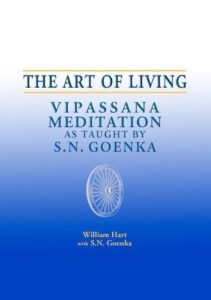
- Article on the art of living according to S.N. Goenka.
- Listen to the day 5 course during Vipassana retreats.
- Read “The Power of Now: A Guide to Spiritual Enlightenment” by Eckhart Tolle.
- Watch the documentary “Doing Time Doing Vipassana”.