
Intermittent fasting is a common practice today. It consists of only eating within an 8-hour window on average. Many choose to skip breakfast and have their first meal of the day at noon. Others prefer to have breakfast but do not eat in the evening.
Intermittent fasting is not strictly speaking a fast. But it has the virtue of providing a window of a few hours where the body, in a state of digestive rest, initiates detoxification mode, as at the beginning of a fast.
The benefits
- Increase in growth hormones. It helps to increase the number of cells in our body, to grow, but also to develop our muscles and bones. They act as a barrier against cellular aging by accelerating the production of new cells.-
- Weight loss and increased life expectancy. By reducing the eating window, and even by having larger meals, we eat less. This reduces the amount of calories consumed. Moreover, several scientific studies have proven that this leads to a better life expectancy.
The other observed benefits of intermittent fasting
- Reduction of inflammatory phenomena.
- Improvement of intellectual functions.
- Reduction of cholesterol, diabetes, and cardiovascular diseases.

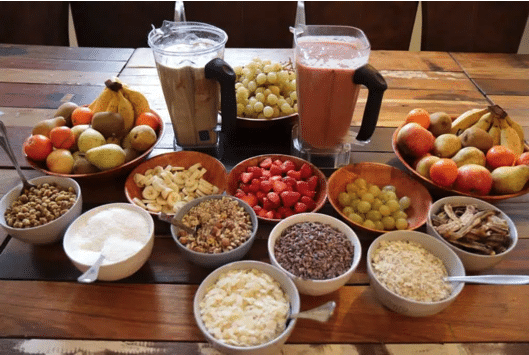
My opinion on intermittent fasting
Intermittent fasting is certainly a way to organize meals that promotes detox and digestive rest.
However, according to my expertise, it is not wise to prioritize this practice over Living Nutrition. Indeed, many people will practice intermittent fasting (often by skipping breakfast) but eat everything, which greatly limits its benefits. The mistake would be, for example, to eat heavy and in large quantities in the evening to last until noon the next day.
I rather advise you to prioritize a maximum proportion of living foods in your day, even if it means eating within a wider time frame than 8 hours. One of the principles of Living Nutrition is to listen to your needs again. So, if your body asks for living food, give it what it needs rather than imposing arbitrary schedules that will disrupt your food cravings and delay this reconnection to the body’s intelligence.
It is important to realize that your mind is not competent to tell you when and what to eat! Only your body, through feeling, can provide you with this information. One of the great virtues of Living Nutrition, combined with naturopathic detox practices that help detoxify deeply, is precisely to gradually reconnect you to your instinct. An instinct that works in reverse when cells are poisoned and they crave non-physiological foods.
What we observe, after a certain time of predominantly eating living foods, is that we are not hungry in the morning upon waking and that we avoid meals after 6 PM (to not disturb sleep). Thus, as we gradually reconnect to the body’s intelligence (which happens progressively over several years), intermittent fasting sets in naturally, not necessarily every day of the week but when it suits the body.