"What you consume becomes a part of you. The closer it is to you evolutionarily, the more it interferes with your system."
Sadhguru
Introduction
“Where do you get your protein?” is undoubtedly the most frequently asked question I have received, which is why it deserved a detailed response in the form of an article. From their discoveries in 1835 to the unfounded myths that have taken hold of the collective unconscious, I invite you to discover our real protein needs according to current science.
Note: All protein values expressed in % in this article indicate a caloric ratio. Thus, 10% of protein in the diet of a person consuming 2000 Kcal corresponds to 200 Kcal from protein, or 50 g of protein (since there are 4 Kcal for 1 g of protein).
The chemistry and role of proteins
Discovered in 1835 in the Netherlands by chemist Gerardus Johannes Mulder, proteins are biological macromolecules present in all living cells. They are coded by a sequence of amino acids, linked together by peptide bonds, which adopts a three-dimensional structure according to a specific folding that allows them to perform various vital biological functions. Generally, a molecule is referred to as a protein if it contains more than fifty amino acids, as a peptide if it contains a few dozen, and as a microprotein if it contains fewer than 10. All proteins from all known living beings are made up of 22 different amino acids known as proteinogenic amino acids. Humans, like most species, only have 20 different proteinogenic amino acids. However, there are about 500 amino acids that play a central role in the physiology of the organism, regardless of their contribution to proteins.
Proteins are classified into different categories:
- Structural proteins that allow the cell to maintain its structure and shape (keratin, collagen, etc.).
- Enzymes that modify the speed of chemical reactions in the cell.
- Motor proteins that enable mobility (actin, myosin, etc.).
- Regulatory proteins that modulate the activity of other proteins and control gene expression.
- Transport proteins that ensure the transfer of different molecules in and out of cells (hemoglobin, albumin, etc.).
- But also defense proteins (antibodies), storage, signaling, communication (hormones), energy (ATP), etc.
The importance of the role of proteins in the human body explains its etymology from the Greek “prôtos”, which means “first”.
Our protein needs
In the 1950s, Dr. William C. Rose conducted experiments on humans (see this article) to determine the so-called “essential” proteinogenic amino acids, those that we need but that our body cannot metabolize. According to his work, 9 of the 20 essential amino acids are (with average daily needs): histidine (700 mg), isoleucine (1,400 mg), leucine (2,730 mg), lysine (2,100 mg), methionine (1,050 mg), phenylalanine (1,750 mg), threonine (1,050 mg), tryptophan (280 mg), and valine (1,820 mg).
The body has the capacity to produce certain amino acids itself, notably the 11 so-called “non-essential” amino acids which are: alanine, asparagine, aspartate, glutamate, glutamine, glycine, proline, serine, tyrosine, cysteine, and arginine. It is also capable of converting certain amino acids into other amino acids, a mechanism that plays an important role in the synthesis and recycling of proteins. Then, depending on its needs, the body produces all its proteins from the amino acids it produces itself, recycles, or derives from the digestion of food. With the indispensable contribution of insulin, amino acids are assembled into proteins within cells according to the instructions recorded in our DNA.
Notes:
– 80% of our amino acid needs come from the recycling of proteins already present in the body.
– The “essential” status of histidine is still debated as the body can produce it but not enough according to experts.
– Dr. Rose’s results should be put into perspective as the values obtained are those that maximize the growth of the organism without considering health.
– Only plants produce essential amino acids. Thus, all animals find their essential amino acids by eating plants or other animals.
Official protein recommendations
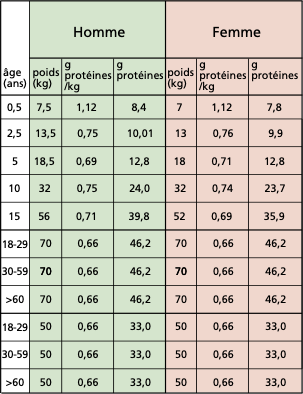
Since the 1980s, the ANSES, the FAO, the UN and the WHO have published reports on our protein needs based on Dr. Rose’s experiments. According to these official organizations, our daily protein needs average 0.66 g of protein per kilogram of body weight, and the recommended dietary allowances, given with a margin of “safety”, are 0.83 g/kg to meet our essential amino acid quota. Even though our protein needs vary depending on our age (see table below), they are naturally met by a caloric ratio of 10% protein. This means that for a person needing 2000 Kcal daily, 160 g of protein is sufficient. Many other official groups such as the U.S. National Academies’ Institute of Medicine and the National Research Council also suggest that consuming only 10% protein is largely sufficient.
Estimation of our protein needs per kilogram of body weight
The protein content (caloric ratio) of foods
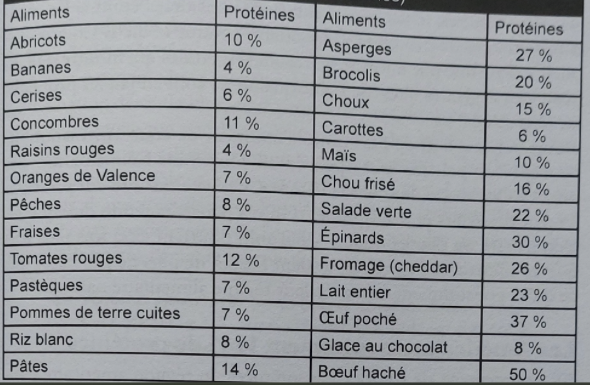
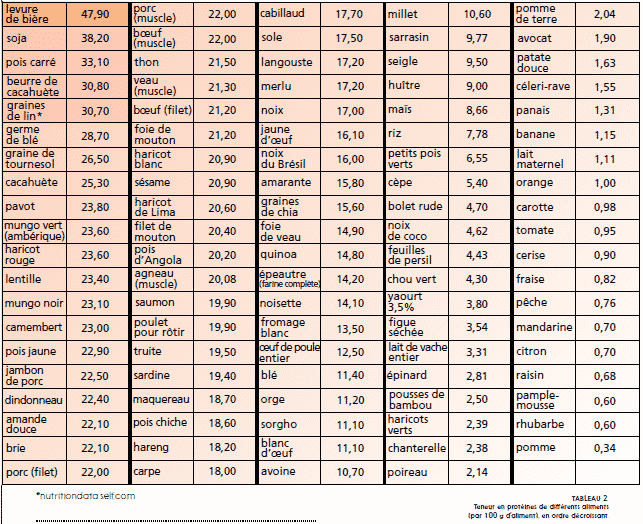
These estimates coincide with what is observed in our primate cousins who are frugivorous. Indeed, according to primatologists, chimpanzees, bonobos, orangutans, and gorillas consume about 7% (caloric ratio) of protein. It is known that fruits contain on average 4-8% protein, and vegetables 30% (see the table above with protein values calculated based on the caloric ratio of the food). It is not a coincidence that fruits and vegetables contain the exact amount of protein necessary for our bodies. And it is also not a coincidence that the minerals they provide are mainly alkaline minerals: calcium, sodium, magnesium, and potassium. Furthermore, as we will see later, and contrary to what can be read in magazines, all these essential amino acids are present in fruits and vegetables.
“In his book, “The China Study”, T. Colin Campbell, a renowned professor of nutritional biochemistry at Cornell University, states that we only need 5-6% protein to replace what we naturally lose. He adds that “for about fifty years, a figure of around 9-10% protein has been recommended to ensure that people consume the 5-6% ‘required’. In addition to the safety margin, this recommendation assumes that most people consume cooked proteins. Since cooking alters proteins and other nutrients, one can consume much less in raw form and still be sure it will be a sufficient amount. Thus, it is understood that a maximum of 10% protein is a sufficient and reasonable figure.” Douglas Graham’s 80/10/10 diet
Note: Heated proteins bond together and create new molecules (a chemical reaction called polymerization), or they bond with sugars (Maillard reaction). However, our digestive system does not have the enzymes required to fully break down these unnatural molecules created by heat into amino acids. This is why cooked proteins are less digestible and release fewer usable amino acids for the body. Moreover, they can damage the intestines and cause certain disorders such as intestinal permeability, allergies, osteoarthritis, etc.
The proteins in breast milk
A simple observation allows us to validate these recommendations, which is that of breast milk. Everyone agrees that it is the best food for babies, at an age when the body is growing and requires the best. Yet, breast milk contains only 6% protein. It is therefore a fact that humans do not need more than 6% protein in their diet, as deduced by T. Colin Campbell.
Notes:
- Cow’s milk is three times more concentrated in protein than breast milk. It is designed for calves and not for human infants, which leads to pain and indigestion in the latter.
- The pasteurized milk given to children would kill a calf. It contains proteins altered by cooking, and some are associated with sugars (Maillard reaction), which creates toxic viscosities.
- Milk, whether raw or cooked, also contains growth hormones, such as IGF-1, which resembles insulin, disrupts sugar metabolism, and is therefore suspected of causing diabetes. These hormones primarily aim to increase the size of the skeleton and muscles, not the brain and nerves, as is the case with human milk, which is richer in fat.
The digestion of proteins
The proteins we consume with food are not absorbed as they are: the intestinal barrier, except in pathological states, is impermeable to large molecules like proteins. To be used by our body, a protein must first be broken down into the different amino acids that compose it: these are then absorbed and used to synthesize new proteins.
Dietary proteins are broken down into amino acids through the action of peptidases that break peptide bonds. First digested in the stomach by the action of hydrochloric acid and pepsin, proteins are degraded into peptides. Then, once they reach the duodenum, various pancreatic and intestinal enzymes break down the proteins into amino acids, which can only then enter the bloodstream via the portal vein to reach the liver, which will redistribute or transform them (according to its needs) into other amino acids, a process called transamination.
Next, cells gather amino acids to make their own proteins. The body produces about 1600 different ones, an assembly process that requires insulin. This pancreatic hormone, which poses problems for diabetics, is therefore not produced solely to digest sugars! For example, digesting 100 g of meat requires as much insulin as 50 g of sugar. This is why an excess of animal proteins promotes insulin dependence.
In addition to these digested proteins daily, the body recycles about 200 g of proteins from dead cells and degraded proteins each day. The inevitable loss of proteins (about 25 g per day) from the body due to unusable worn-out proteins, as well as the excess proteins brought by the diet (everything consumed beyond 0.66 g per kg of body weight), are degraded by the liver into ammonia (a toxic substance) and then into urea before being eliminated by the kidneys during urination.
Animal Proteins VS Plant Proteins
Biochemical analysis shows that every food contains the complete set of amino acids, including the essentials, contrary to claims that can be read or heard everywhere in France, including on the official site of the PNNS (France: National Program for Nutrition and Health). Even though many plant proteins contain slightly less of certain essential amino acids (like lysine and methionine) than animal proteins, they still contain enough to meet needs, even with an exclusively plant-based diet.
“According to the American Heart Association, it is not necessary to consume animal proteins to have enough protein in one’s diet: plant proteins can provide sufficient essential and non-essential amino acids, provided that the sources of dietary protein are varied and that caloric intake is sufficient to meet energy needs. It is not necessary to combine them in the same meal.” Wikipedia
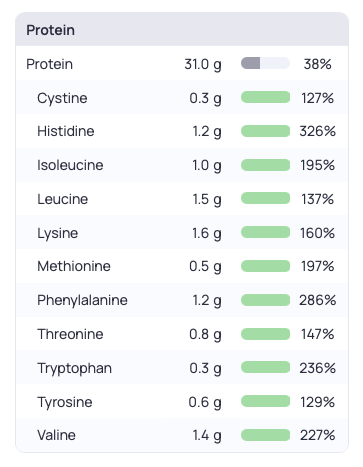
A claim that can be easily verified via the app Cronometer by measuring the amino acids contained in the fruits and vegetables that a raw vegan consumes in a day. To simplify, let’s take: 1.5 kilos of oranges, 1.5 kg of bananas, and 200 g of spinach. These foods represent 2069 Kcal with 31 g of protein, which is a protein intake of 6%. As can be seen in the following table, all essential amino acids are present and in proportions exceeding the needs estimated by the FAO/UN/WHO/ANSES.
The amino acids contained in 1.5 kilos of oranges, 1.5 kilos of bananas, and 200g of spinach
Note: I deliberately chose a sample of fruits and vegetables omitting seeds & nuts, which are very rich in proteins (see the table below), to show that oilseeds are not necessary to meet our protein needs, nor in lipids (see this article).
With this simple example (which you can reproduce infinitely by combining fruits, vegetables, and nuts of your choice), we see that our protein needs are met with raw plant foods, without needing to add grains and legumes in the “right” proportions. As for the digestibility of these proteins (what portion is actually absorbed by the digestive system?), even if it is not 100%, it does not really matter since all contributions of these 9 essential amino acids are far above the needs. Moreover, since they are consumed raw, they are necessarily more digestible and assimilable than if they were cooked, due to the chemical phenomenon of polymerization that occurs under the effect of heat and produces carcinogenic heterocyclic amines (see the paragraph on official recommendations).
“In the 70s, people tried to combine proteins in such a way that they consumed all amino acids at each meal. Years later, studies demonstrated that this approach was unnecessary. Moreover, 20 years after writing “the theory of incomplete protein,” its author, Frances Moore Lappé, changed her mind, admitting that she had made a big mistake. We do need all essential amino acids, but we are not obliged to consume them all in one meal or even in one day.” The 80/10/10 diet by Douglas Graham
To conclude the comparison, the following table unequivocally shows that, contrary to popular beliefs, it is plants that are richest in proteins:
Protein content of foods per 100g of food
The danger of animal proteins
A) Undesirable amino acids from animal proteins
On the other hand, not all proteins are equal, and those of animal origin predispose to cardiovascular diseases for several reasons. On one hand, methionine, an amino acid very present in animal proteins and also in legumes, transforms into homocysteine, which damages the cardiovascular system (it contributes to the formation of blood clots) and promotes cancer and aging. On the other hand, animal proteins are most often accompanied by saturated fats and residues of antibiotics and vaccines. Furthermore, heterocyclic amines produced during the cooking of animal proteins are also a risk factor for certain cancers (colon and bladder). According to WHO, eating fifty grams of processed meat (curing, aging, fermentation, smoking, etc.) per day increases the risk of colorectal cancer by 18%. Finally, animal proteins are rich in non-essential amino acids cysteine and cystine, which are involved in the formation of uric acid crystals and kidney stones.
B) Animal proteins contain acidifying purines
Another notable difference between plant and animal proteins is the presence of purines in the latter, a nitrogenous molecule found in their DNA and RNA. Purines are mainly present in animal proteins, but they are also found to a lesser extent in legumes, coffee, cocoa, tea, and alcoholic beverages. The body eliminates purines by transforming them into uric acid, a weakly soluble acid that acidifies saliva (cavities), urine (cystitis and lithiasis), and blood. When the blood becomes even slightly acidic, amino acids tend to bind to minerals, metals, and lipids, which hinders their proper assimilation and creates toxic compounds, coagulations (the blood thickens with a risk of hypertension and stroke) and lithiasis (urate, oxalate, and phosphate stones). Unlike carnivorous animals, we do not produce uricase (an enzyme) to solubilize uric acid into allantoin, a compound 5 to 10 times more soluble than uric acid. In excess, the body stores uric acid in the form of acid crystals that cause pain and inflammation where they deposit. It is uric acid that, among other things, is responsible for gout, arthritis, kidney stones, etc., and which progressively demineralizes the body (risk of osteoporosis and cavities) by causing a loss of alkaline minerals, particularly calcium and magnesium.
“In general, protein-rich foods promote the formation of acidity in the body. This is also true for protein-rich plants like legumes. In fact, the minerals present in proteins are acidic minerals like chlorine, phosphorus, and sulfur. To maintain homeostasis, the body must compensate for the acidity caused by excessive protein consumption. Unfortunately, to do this, it must partly extract alkaline minerals – calcium – which are precious for bones. Consequently, a constant level of calcium in the blood is required, and the body then replaces the absent calcium by drawing it from teeth or bones, marking the beginning of osteoporosis or the appearance of cavities.” The 80/10/10 diet by Douglas Graham
In addition to these disadvantages related to the nature of animal proteins, it can also be added that:
- Animal proteins generate, in addition to uric acid, pyrimidines, sulfuric and phosphoric acids.
- Some exogenous proteins from animal products (casein, homoprotein, albumin, etc.) can irritate tissues and create inflammation and endogenous mucus.
- If the transit time of animal-derived foods in the digestive system exceeds 24 hours (which is most often the case), then anaerobic bacteria decompose the residues of undigested food (putrefaction) and produce ptomaines (cadaverine, muscarine, neurine, ptomatropine, putrescine, etc.), indole, leucomaines, scatol, mercaptans, ammonia, methane, hydrogen sulfide. This is why the consumption of animal proteins causes putrid gas and foul-smelling stools. Moreover, these toxic substances will gradually accumulate in the colon and cause a generalized toxic state in the body.
- Ketone bodies are also produced during their digestion and are eliminated via the lungs, which gives a strong odor to the breath.
All this explains why during World War II, cardiovascular diseases decreased by 50% in Europe. Simply because the population ate much less animal protein, sugar, and fat, while being more active.
C) Addiction to animal proteins
Why, despite all these unfortunate health consequences, do humans continue to consume animal products? In short, it is because animal proteins (and also legumes and certain grains, see this article), due to their toxicity, stimulate the immune system, which invigorates and accelerates transit in the short term. Furthermore, animal products provide adrenaline (produced by the stress related to their breeding conditions and their death in slaughterhouses or hunting) that gives a deceptive feeling of energy that, in the long run, weakens the adrenal glands (like with coffee). In summary, the consumption of animal proteins acts as a stimulant that invigorates organisms lacking vigor.
To go further on the uselessness (outside of survival periods) and the harmfulness of animal proteins, read these 4 articles:
- “The Origins of Living Nutrition”
- “What is the ideal % of Living Nutrition for everyone?”
- “What about B12 in living nutrition?”
- “Living nutrition VS keto-carnivore diet”
The myths surrounding proteins
a) Unlikely deficiencies
The fear of lacking protein has decidedly mysterious origins that the famous hygienist Herbert Shelton denounced 60 years ago! One can certainly die of malnutrition, but certainly not from a lack of protein; this has never been seen… Simply because proteins are everywhere and in sufficient quantities, including in fruits and vegetables.
“In developing countries where there is not enough food available and where people literally die of hunger, there are indeed diseases related to protein/calorie deficiency, such as marasmus or kwashiorkor. But these diseases do not exist in developed countries. The symptoms — extreme thinness, fatigue… It is much more likely that a person encounters social, nutritional, or health problems long before developing a protein deficiency. Protein deficiency does not exist among us.” The 80/10/10 diet by Douglas Graham
b) Plant proteins would be of poor quality
The origin of the myth of poor-quality proteins can be traced back to studies conducted on rats in the early 20th century. In a series of experiments on rodents, researchers, who at the time were studying the nature and composition of proteins, found that rats grew better with casein (milk protein) than with zein (corn protein). It is this experiment that opened the door to the myth of so-called “inferior quality” plant proteins. There was then the quality assessment of proteins based on a reference protein similar to that found in eggs. This gave rise to the myth that plant proteins are inferior to animal proteins. However, following this logic to the end, it would be human flesh that is the most nourishing (see this fascinating video with Miguel Barthéléry – Translation note: this video is currently in French, but you can activate YouTube’s auto-generated subtitles in English while we work on providing a dedicated English version.)… Moreover, in yogic tradition, it is believed that foods genetically close to humans (like mammal meat) are more difficult to assimilate without impacting the body and mind. The reason is that they contain forms of “cellular memory” or biological information that can influence our subtle internal processes (yoga, meditation, mental clarity). The human system, to remain light, calm, and energetically open, would therefore need simple and “non-intrusive” food on an informational level, like that found in the plant kingdom.
“Popular nutritional science defines the quality of proteins based on the effectiveness with which they promote growth rather than concerning themselves with whether they allow for good health. Thus, according to these criteria, milk and eggs are considered the best sources of protein. However, as T. Colin Campbell says, ‘there is a huge pile of study results showing that so-called ‘low-quality’ plant proteins… are actually the healthiest proteins.’” The 80/10/10 Diet by Douglas Graham
To learn more about the quality of plant proteins, read this article in French. (Translation note: to read it in English or another language, simply copy the URL and paste it into Google Translate https://translate.google.com/?sl=fr&tl=it&op=translate)
C) Proteins for building muscle
According to official reports from ANSES, FAO, the UN, and WHO, our protein needs (in caloric ratio) vary little depending on our activity (see table below), for the simple reason that the more active we are, the more we eat! Therefore, an athlete does not need more protein-rich foods than a sedentary person; they just need to consume more calories.
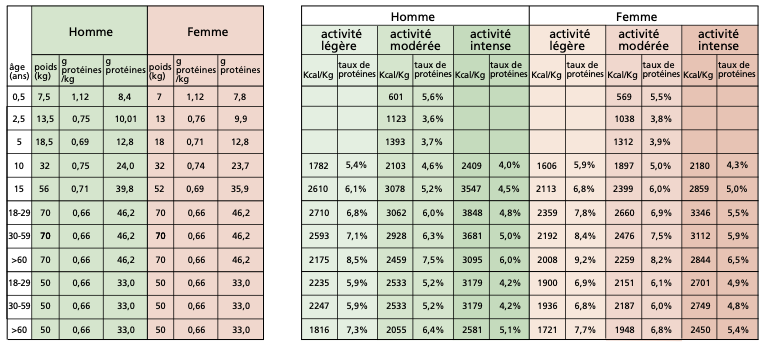
“Bodybuilders will surely be interested to know that a study from the Institute of Medicine/Nutrition and Food Committee on protein needs concluded that there is no need to consume more protein than the amount recommended by the RDA when engaging in physical activity.” The 80/10/10 Diet by Douglas Graham
To better understand the origins of myths surrounding proteins, read “The China Study” by T. Colin Campbell, an American scientist who grew up on a farm before becoming a doctor and revolutionizing our beliefs about animal proteins.
d) Fasting causes muscle loss
Another false belief! Dr. Valter Longo, an Italian-American researcher, studied the effects of fasting on health, aging, and diseases. According to his well-regarded work in the field, protein losses are minimal during fasts of a few days (3 to 5 days), as long as fat reserves are sufficient (beyond 5% of body mass). This contradicts the idea that the body “degrades muscle” as soon as we stop eating. On the contrary, fasting stimulates the production of growth hormones and thus muscle gain.
The losses in muscle volume that are sometimes observed during fasting or when starting a plant-based and living diet concern the elimination of water (held in the form of retention) and low-quality fats that artificially inflate the muscles (marbled muscles) without granting them more strength..
To learn more about this, read the practical guide to fasting and watch this ARTE film on fasting.
The risks associated with excessive protein consumption
As previously mentioned, animal proteins are inherently very acidifying and sources of putrefaction in the colon. Furthermore, according to the findings of Dr. T. Colin Campbell, the development of cancer cells is triggered when the amount of animal protein exceeds the 10% mark. This raises questions about official recommendations and those from the press…“The recommendations found in the press range from 10 to 35% protein, and Americans consume an average of 16%.” The 80/10/10 Diet by Douglas Graham Moreover, when there is excessive protein consumption (beyond 6% as noted), the body can burn some of it as glucose or store it as fat, but the majority will be eliminated by the kidneys (⅔) and intestines (⅓), producing a whole array of acids, including uric acid. The excess protein fraction that the body could not eliminate in this way, for example, if the kidneys are not strong enough, will thicken the blood while waiting to be stored in the blood vessels. This protein storage mechanism (unfortunately little known) is responsible for varicose veins and thickening of the blood vessel walls (increasing the risk of atherosclerosis) which, over time, take on a pronounced red color (like couperose). This is why people described as “sanguine” for having a red complexion have blood loaded with acids and excess proteins. Besides the cardiovascular problems this causes, this accumulation of proteins makes capillaries less permeable to nutrients and oxygen. This can lead to congestion, chilliness, and deficiencies because it is at the capillary level that cellular exchanges occur.
“Too much protein in our diet causes all sorts of health problems. Among these, symptoms such as constipation and other digestive disorders often lead to toxemia (toxic blood and tissues) and, eventually, cancer. Other consequences of a diet too rich in protein include: autoimmune dysfunction, arthritis, and any other autoimmune disease, premature aging, liver failure, kidney failure, osteoporosis, and many other degenerative and pathogenic conditions.” The 80/10/10 Diet by Douglas Graham