"The only thing we have to fear is fear itself."
Franklin Roosevelt
Here is the result of reflections on vitamin B12 deficiencies, summarized in 7 steps:
Step 1: Let’s go back to basics with some reminders that are never superfluous about our origins
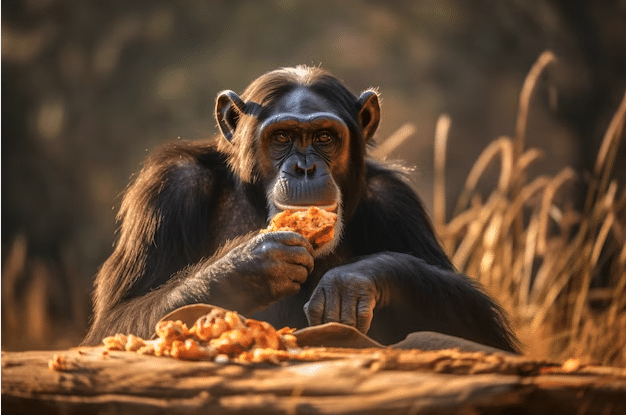
Humans are primates belonging to the great ape family. This family also includes the bonobo, orangutan, chimpanzee, and gorilla. These species are frugivorous (between 95 and 99%) and occasionally eat small animals and insects. Except for bonobos and the gorilla, the largest of the primates, which is (almost) exclusively vegan (with a few insects).
Considering the phylogenetic tree from which humans originated, it makes sense to consider that humans are also, at their core, frugivorous. The question is whether the small amount of animal protein consumed by bonobos, chimpanzees, and orangutans is a biological necessity for them or if it is merely an adaptive capacity left to these species to adapt in case of food shortages, for example due to climate change, thus increasing their chances of survival.
From my point of view, all great apes can thrive on an exclusively vegan diet, and if they eat something else, it is simply out of opportunism. Two reasons suggest that this small amount of animal protein in great apes is not a necessity. On one hand, the example of the gorilla clearly shows that it is possible to live being (almost) exclusively vegan, moreover without being rachitic. On the other hand, there is nothing essential found in animal products that we cannot find in the plant kingdom or that is not produced by our microbiota. This raises the famous question of B12….
In the meantime, to summarize, if you are afraid of lacking protein and B12, seriously ask yourself where gorillas find theirs… You might object that humans are not like other animals and that they became hunter-gatherers about 2 million years ago. That is true, but their digestive system inherited from 65 million years ago (the appearance of primates) has retained all the characteristics of a frugivore. If we have been able to significantly modify our diet, it is solely through our technological inventions, the first being throwing weapons and stone tools. We can be proud of our ingenuity and great adaptability, but the dietary changes induced remain unnatural. The technology that alters our diet is therefore not a recent phenomenon; it dates back to the appearance of homo sapiens sapiens and not to the last industrial revolution.
To learn more about this subject, read: “The Origins of Living Nutrition”
Step 2: What is vitamin B12 and where is it found?
B12 is a vitamin that contributes to the proper functioning of the nervous system and the production of red blood cells. It is therefore important but not more so than other vitamins. If it is so famous, it is because it is not found in significant quantities in plants and fruits, which leads to the belief that one will be deficient in B12 if one is vegan or even vegetarian.
Small parentheses:
- Being vegan does not inform us about the quality of our diet and is not at all a guarantee of good health. Indeed, one can very well be vegan and survive on coffee, cigarettes, and starches (for example). That is why we talk here about plant-based and living nutrition.
- A vegetarian who still consumes dairy products and/or eggs will obtain their B12 exogenously through these foods that contain it.
The only organisms capable of producing B12 are microorganisms. No known animal or plant has the enzymatic tools to produce it. It is only by ingesting bacteria, microscopic algae, and yeasts or by associating with them that animals and plants enrich themselves with B12.
That is why we will mainly find B12 in animal products but also in algae. If the main source of this vitamin is found in animal proteins, it is simply because the animals themselves are supplemented with vitamin B12 through their diet and… their microbiota! And for good reason (let’s remember): the only living organisms capable of synthesizing B12 are microorganisms.
There are 3 main natural forms of vitamin B12: methylcobalamin, adenosylcobalamin, and hydroxocobalamin. This detail is important because some supplements are not produced from the natural forms of B12 but with a synthetic form: cyanocobalamin.
Step 3: The role of our microbiota
It is estimated that our digestive system houses about 100 trillion bacteria, which is what we call the intestinal microbiota or gut flora. These bacteria that colonize us live in symbiosis with their host, that is to say, us. A symbiosis is a lasting biological association that is mutually beneficial between two living organisms. The deal established with them is that we provide them with a habitat to live in with food (the soluble and insoluble fibers from plants) and, in return, they contribute to the survival of their host by supporting our immune system and providing us with what we do not find in our preferred foods, namely, fruits.
If we synthesize what has been written previously, we have a frugivore digestive system housing about 100 trillion bacteria, of which we know they are the only ones capable of producing something vital for us: B12. Do you think they have forgotten what their host needs to survive? Unlikely! Moreover, it has been proven that the microbiota produces B12, but some “specialists” believe it is not absorbable because it is produced too far down the digestive system. How can one think for a second that a vital vitamin in the body could be produced and not absorbed? The body is not the type to do things for nothing…
In summary, it is reasonable to think that a vegan obtains their vitamin B12 from the bacteria living in symbiosis in the digestive system.
Step 4: B12 deficiencies
Currently, B12 deficiencies mainly concern farm animals (fed grains and flours) and humans who eat “everything.” This deficiency is absolutely not the exclusive domain of vegans! In both humans and animals, it is merely a reflection of an unbalanced gut flora, resulting from a lack of living and appropriate food in the diet.
It is important to understand that the bacteria in our microbiota feed on the fibers (soluble and insoluble) from raw vegetables, fruits, and vegetable juices. This explains why vegetable juices are important. They repair this vital gut flora even in those who have intestines too irritated to digest raw vegetables.
To summarize: By eating plant-based & living and supplementing, according to your desires, with algae & lacto-fermented vegetables (in juice or raw), vitamin B12 (like the other B vitamins) will be produced by the gut flora (if it is functional), in quantity & quality according to your body’s needs!
Step 5: B12 supplementation
Humanity produces 80 tons of synthetic B12 each year, mainly for livestock!
Indeed, intensive farm animals are deficient in B12 since they no longer eat fresh food from the ground. They are fed industrial and pasteurized flours and pellets, supplemented with synthetic vitamins… Consequently, when consuming farm animal products, it is synthetic B12 that is ingested.
Moreover, B12 supplementation is not a solution in itself because nothing guarantees that it is absorbable by the tissues or usable by the cells (in this regard, read the article “Filling Your Deficiencies“). Furthermore, since there are 3 main types of vitamin B12, how can one know which ones are needed and in what proportion? These considerations certainly explain why even those who eat “everything” are also subject to B12 deficiency.
Supplementing with B12 in the long term seems contradictory to the principles of hygiene that advocate harmony with nature! If one believes they need exogenous B12, it makes more sense to consume it with animal products (not from intensive farming) than to resort to synthetic supplements, except in very specific cases (proven deficiencies) and occasionally. It is also possible to supplement with spirulina (which contains methylcobalamin, an absorbable form) at a rate of 1 tablespoon per day to meet daily needs (assuming the body is not able to produce its own B12).
Step 6: I would be “deficient” in B12 and I am doing well!
Some claim that people who only eat living plant-based food without supplementing with B12 will eventually become deficient when their reserves (in the liver, in particular) are depleted. In all transparency, I share my blood tests taken in 2018 (during The Fasting Walk) and in 2020 (during The Footprint).
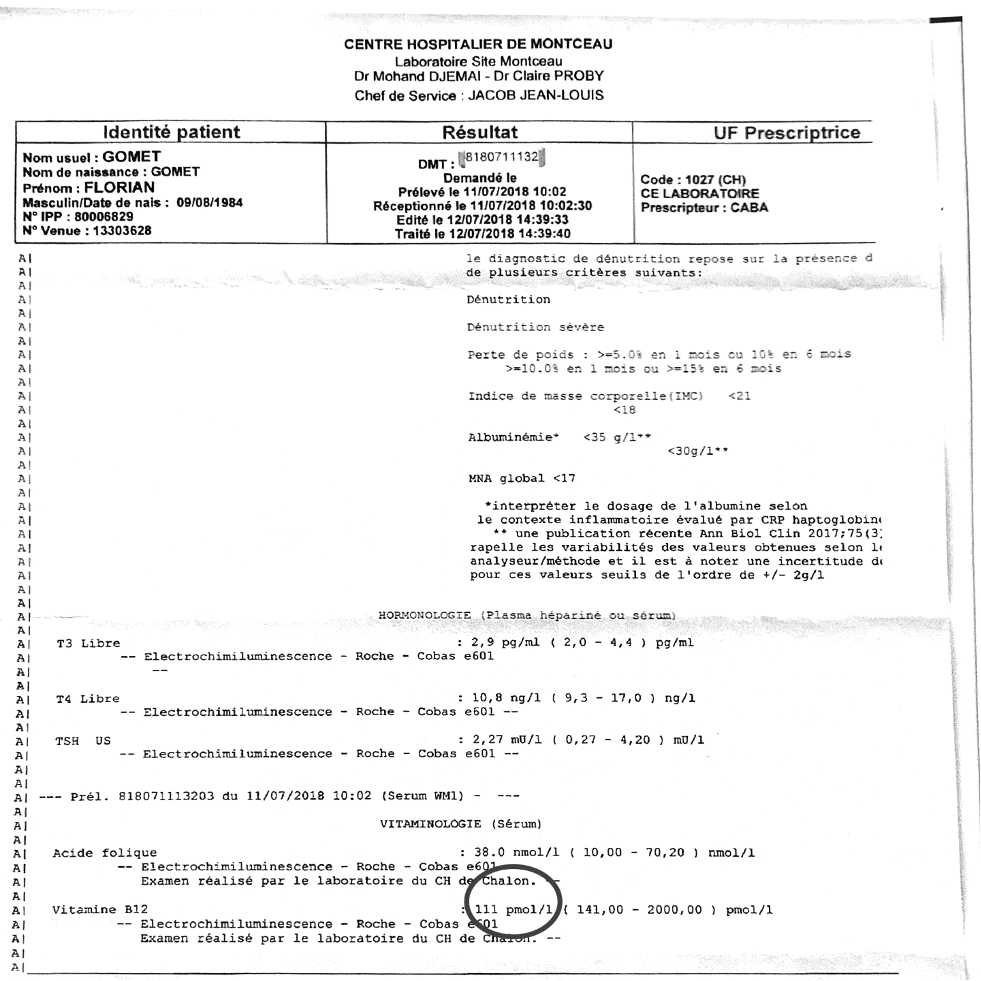
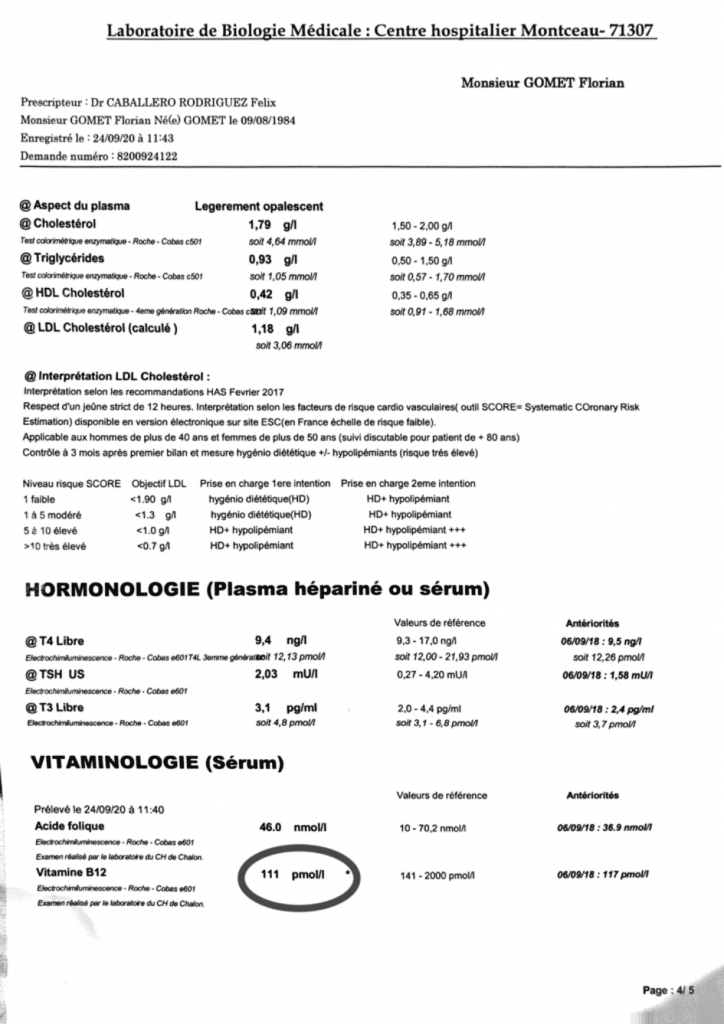
It can be seen that my B12 level is 111 pmol/l in 2018 and in 2020 (with a rise to 117 pmol/l in September 2018 after 2 weeks of fasting), which tends to prove that my B12 reserves have not decreased. That said, the norm is between a range of 141 and 2000 pmol/l. I am therefore slightly below the threshold chosen by this laboratory. As for whether I am deficient or not, it all depends on the relevance of this low range. It was certainly established based on observations made among a population with an excessive consumption of animal proteins, and we are not sure it is accurate. Moreover, since this vitamin is vital, I should feel unwell if I were truly deficient, and I do not see how I could have accomplished all these expeditions ! To be more precise, and as proof of what I am stating, a true deficiency in B12 automatically leads to a decrease in red blood cell production, whereas this rate is normal for me. QED.
Epilogue : 5 years later, in 2025, without having ingested a single gram of animal protein, my B12 level has risen from 111 to 158 pmol/l.
Step 7: My expertise
When one starts living nutrition, one enters an alchemical process of regeneration that will go through ups and downs. The downs being the elimination crises during which one may feel unwell and weak. That is why naturopathic detox techniques are used to shorten these bad moments. If one still believes that they will lack protein or B12, their mind will convince them that they feel unwell because they no longer eat animal products and that it is dangerous. We underestimate how far the roots of this belief go… If, at that moment, one does a blood test and B12 is below the norm, then one rushes to eat eggs, meat, or take B12 in drops, etc. Eventually, one goes on a crusade on social media to warn against B12 deficiencies…
If one listens to their fears by supplementing with B12, placebo effect obliges, it may be that one feels immediately better the moment they take the drops (even though such an effect is biologically impossible). But not for long, because the root causes of all diseases have still not been addressed: toxemia (from the hygienist perspective). Only a predominantly plant-based and living diet accompanied by regular naturopathic detox techniques can effectively reduce it.
To learn more about this subject, read “Cleanses, the Keystone“.
Some sources on B12:
“The Zen Detox Cure” Volume 1 by Nelly Grosjean and Miguel Barthéléry
File from the CHU of Strasbourg
https://www.alimentationvivante.com/vitamine-b12-complement/
https://www.cahiers-antispecistes.org/les-animaux-emballages/
The links above point to websites in French. To read them in English or another language, simply copy the URL and paste it into Google Translate https://translate.google.com/?sl=fr&tl=it&op=translate.