My expertise
All the observations I have made in recent years have convinced me of the great benefits of hygieneism on all our bodies: physical, mental, emotional, and energetic. However, the most advanced hygieneism, while optimizing the capabilities of our physical body (with significant repercussions on our other bodies), is not sufficient for our full flourishing if we do not also take care of what is commonly referred to as ‘personal development’ (cf “The Limits of Hygienism”).
On one hand, the psychodynamic aspect seems crucial to me in that hygienist tools are useless if psychological barriers limit or even block their use. It is these barriers that often dissuade people from engaging in the healing process. And on the other hand, because optimal health is not limited to that of the body, even if taking care of our earthly vehicle greatly influences our experience of life. As Socrates supposedly said: “Is there a greater good for humans than health?”
Each person’s life is fundamentally just a succession of feelings that is why the central problem that remains, regardless of the number of days of fasting, purges, and hygienist practices, is what we call the wounds of the soul. Beneath all the layers of our toxins and emotions stored in the body lies our vision of life (our beliefs) that creates our reality (to learn more about this, read the article “The Law of Attraction and the Power of Thought”). And this is greatly distorted by our wounds.
Where do these wounds of the soul come from?
At birth, we transition from a state of fusion with our mother to the status of a unique, vulnerable, and dependent being arriving in a hostile environment where the sensations of cold and hunger exist.
Whether we had a beautiful childhood or not, the construction of our individuality (this transition from child to adult) necessarily involves difficult moments that will mark us. Depending on what our soul came to experience (a decision made by our higher Self before incarnation), we will be more sensitive to certain events than to others. Ultimately, it is more our perception of a situation than the situation itself that will create our wounds. Our soul is indeed more sensitive to certain injunctions, traumas, remarks, etc., depending on what our soul came to experience, learn, and then heal.
A child is made up of pure love energy, and when a person or a situation hurts them, they will develop a belief (about themselves or the world) and a filter on reality that will confirm this belief, in order to justify that what they experienced was right. The trauma can sometimes be so intense for the child (abandonment, abuse, violence, rape, etc.) that the resulting belief helps the child accept the unacceptable. It is a survival attitude without which the child would perish.
Since the child’s survival is closely tied to the people who care for them, the child adapts to this (sometimes hostile) environment by establishing a belief about themselves or the world. To adapt and survive, the child may, for example, believe that they deserve to be beaten in order to legitimize their parents’ behavior. Whether in extreme situations of violence or mundane situations, we always find material during childhood to establish beliefs in order to adapt to our environment but also to forge our identity.
The downside, as we will see later in this article, is that we unknowingly retain these beliefs once we reach adulthood, even though we are no longer dependent on our parents and we evolve in a completely different environment: that of work, love, friendship, neighborhood, etc. It is at this moment that we experience how much we create our reality when we observe ourselves selecting information in reality that confirms our beliefs and makes us sensitive to certain topics that awaken in us the unhealed wound.
The 4 stages of childhood according to Lise Bourbeau
According to her, most children go through four stages. “After experiencing the joy of being themselves, the first stage of their existence, they experience the pain of not being allowed to be themselves, which is the second stage. Then comes the crisis period, the revolt, the third stage. In order to reduce the pain, the child resigns and eventually creates a new personality to become what others want them to be. Some people remain stuck in the third stage throughout their lives, meaning they are continuously reactive, angry, or in crisis.
It is during the third and fourth stages that we create several masks (new personalities) that serve to protect us from the suffering experienced during the second stage.”
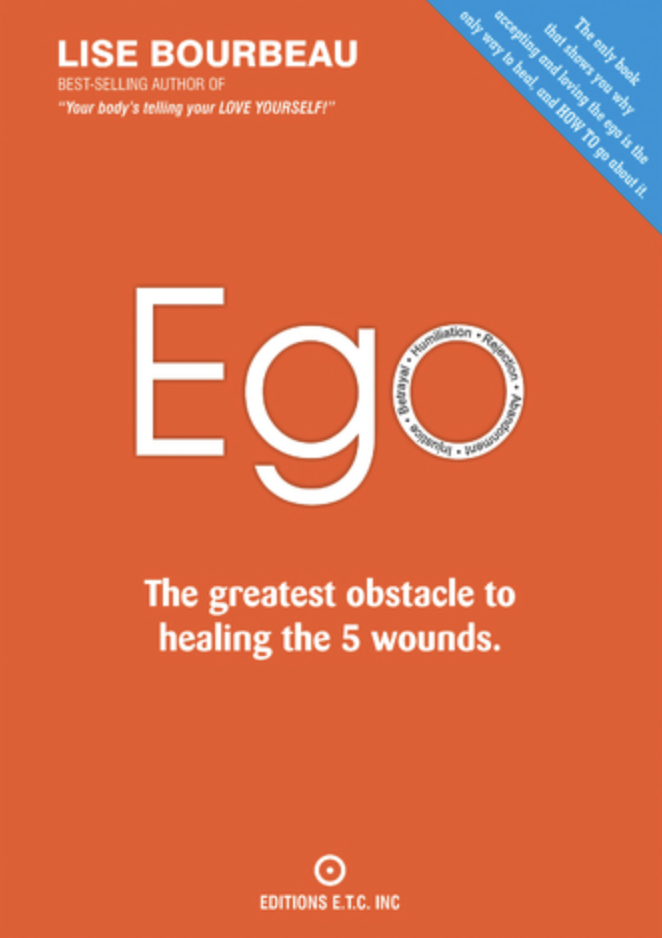
For Lise Bourbeau, these masks number five and correspond to five major core wounds experienced by humans.
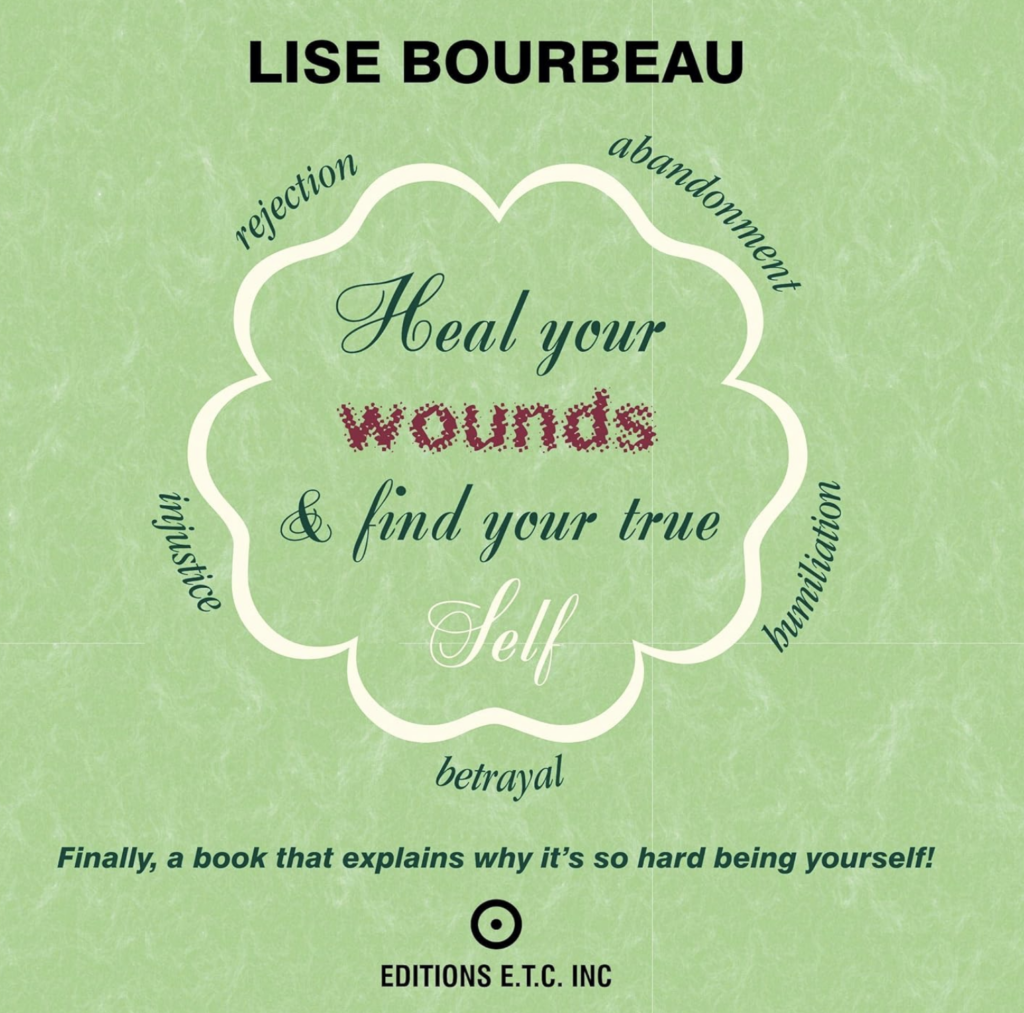
The 5 wounds of the soul according to Lise Bourbeau
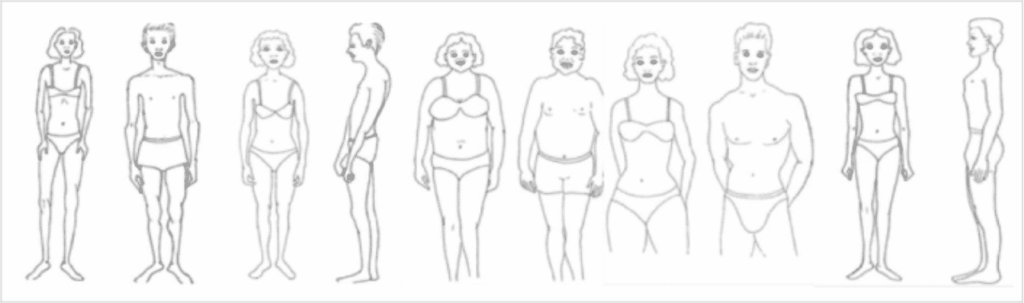
- The wound of Rejection when one did not feel entitled to exist in their first year of life. When this wound is activated, the person wears the mask of the Avoidant and their body is thin and contracted. Their fear is panic. They tend to flee or isolate themselves.
- The wound of Abandonment when, between one and three years old, one lacked emotional nourishment. When this wound is activated, the person wears the mask of the Dependent and their body is slender and flaccid. Their fear is loneliness, and they tend to pity themselves.
- The wound of Humiliation when, between one and three years old, one lacked freedom and felt humiliated by their parents’ control. When this wound is activated, the person wears the mask of the Masochist and their body tends toward obesity. Their fear is freedom, and they tend to submit and serve others.
- The wound of Betrayal when, between two and four years old, one had unmet expectations in connection with the opposite-sex parent. When this wound is activated, the person wears the mask of the Controlling and their body is muscular, exhibiting strength and power. Their fear is separation, and they tend to get angry, blame, and become impatient.
The wound of Injustice when, between four and six years old, one felt the need to perform and be perfect. When this wound is activated, the person wears the mask of the Rigid and their body is straight, rigid, and as perfect as possible. Their fear is coldness, and they tend to become cold, firm, and take a controlling position.
For more details on this subject, it is best to read “ Heal your wounds and find your true self” by Lise Bourbeau.
According to other authors & therapists, there would be other wounds such as: exclusion, powerlessness, uselessness, guilt, etc.
Even if the previous description remains an approximate model of reality, it has the merit of helping us to know ourselves better and to understand how we function. It also has the merit of explaining many seemingly dramatic and repetitive situations.
Furthermore, we can learn to be fair, sociable, and develop qualities such as NVC (non-violent communication), etc., but when a wound is activated by a person or a situation, we unconsciously put on a mask. We then react irresistibly, setting aside the qualities we were trying to cultivate.
That is why it is so important to know our wounds, lest we be eternally in excessive reaction on certain subjects as if we were reacting to the weight of all the times we had experienced a similar situation, unjustly making one person pay for all the others. This is why we adopt disproportionate and inappropriate attitudes in certain particular situations that activate our wounds.
Another interest in knowing our wounds arises when it comes to interpreting what we feel to assess a situation or make a choice. We are increasingly taught to listen to our emotions and to live them, which is good in itself. But when a wound is activated repeatedly, it can become problematic for ourselves and others. This is where it is important to know oneself, to objectively assess a situation, to understand where the emotion comes from, and to fully accept it. Otherwise, we end up exploding sooner or later. Ultimately, our emotions say more about us than about an event or a person. This is where it is appropriate to differentiate emotion from felt.
Emotion versus Felt
- An emotion comes from the ego, is felt in the solar plexus, it is exhausting, seeks to accuse, creates fears or anger, and incites control. Emotion arises when a wound is activated and gives us subjective information, information read through a filter distorting reality.
- Felt comes from the heart, is felt throughout the body in a circulating, observing energy, which gives a feeling of mastery. Felt arises from objective information.
Even if our emotions give us accurate information about our environment, the trap is to forget that they are perceived through a magnifying and distorting filter because they are linked to a wound. It is this distinction, between emotion and felt, that we think of when we read this maxim of Socrates: “Know thyself and you will know the universe and its gods”.
The origin of suffering
Suffering does not arise from an emotion in itself but from the resistance we oppose to it by preventing ourselves from fully experiencing it. Even laughter is an energy that, if contained, becomes painful. All so-called “negative” emotions, if fully accepted (that is, if we allow ourselves to be traversed by them), can generate a pleasant feeling. Ultimately, it is the fear and flight from suffering that creates suffering. As Roosevelt said: “The only thing we have to fear is fear itself”.
When we experience trauma and prevent ourselves from fully living the associated emotions (sometimes it is necessary because they are too strong), we energetically store in our bodies a tension with a very particular frequency that will later need to be relived during a situation in life similar to the initial trauma. Thus, the more we live our emotions, the more we free our bodies from their energetic tensions, and the more we lighten this weight, just as elimination crises free our physical bodies from toxins. And once our organism has fully experienced the emotions that had been stored, particularly at the moment when the wounds of the soul appeared (but also with cellular memories), then the wound no longer activates and can be considered healed.
The interest of fully living our emotions is that in the long run we thus drop certain masks and beliefs that had their reason for being in childhood in order to adapt to our environment at the time, but which were inappropriate for our adult daily life. Moreover, when we wear masks, we unconsciously create situations that will lead us to relive the emotion we had cut ourselves off from, as if life served us on a platter theater scenes adapted for us to heal our wounds.
These emotions can be fully experienced by crying, shouting, or, when the work is rough, simply by being fully aware of the sensations it evokes in the body.
The steps towards healing
These steps are described in another volume by Lise Bourbeau: “The Healing of the 5 Wounds”. The key to this healing, easier said than done, is to accept our emotions and stop fighting against them.
We could describe this process of healing the wounds of the soul in four steps. When an emotion appears:
- Recognize and identify this emotion, know where it comes from, and accept it without necessarily agreeing with the fact that it is there.
- Express this emotion in a measured way once the pressure has subsided. This step may, beforehand, go through an outlet like sports or going to scream in the forest. It is then about “disarming the bombs”.
- Convince oneself that everything we experience is normal, even in painful moments and when we feel lost. Also remember that it is the desire to flee from the emotion that creates the pain.
- Say “Thank you” to life even when it hurts because it is in its infinite love that it makes us relive all these emotions so that we can free ourselves from their weight.
Throughout this process it is important not to look for a scapegoat, otherwise the emotion will store again and life will then have to recreate a scene a little stronger for the emotion to be experienced. All these wounds on the path to healing reward us, in passing, with qualities specific to our wounds that make us who we are, rich in our “successes” as well as our “failures”. The two sides of the same coin that always lead to a little more love and consciousness in matter.