
"And those who danced were considered insane by those who could not hear the music."
Nietzsche
"One of the most difficult things is not to change society - but to change yourself."
Nelson Mandela
Everyone talks about it as a necessity, both individual and collective, but do we truly grasp what a real change entails? If we look back at the civilizational changes that have occurred in the past, we see that they have been accompanied by a change in diet.
The dietary changes of the past
For the record:
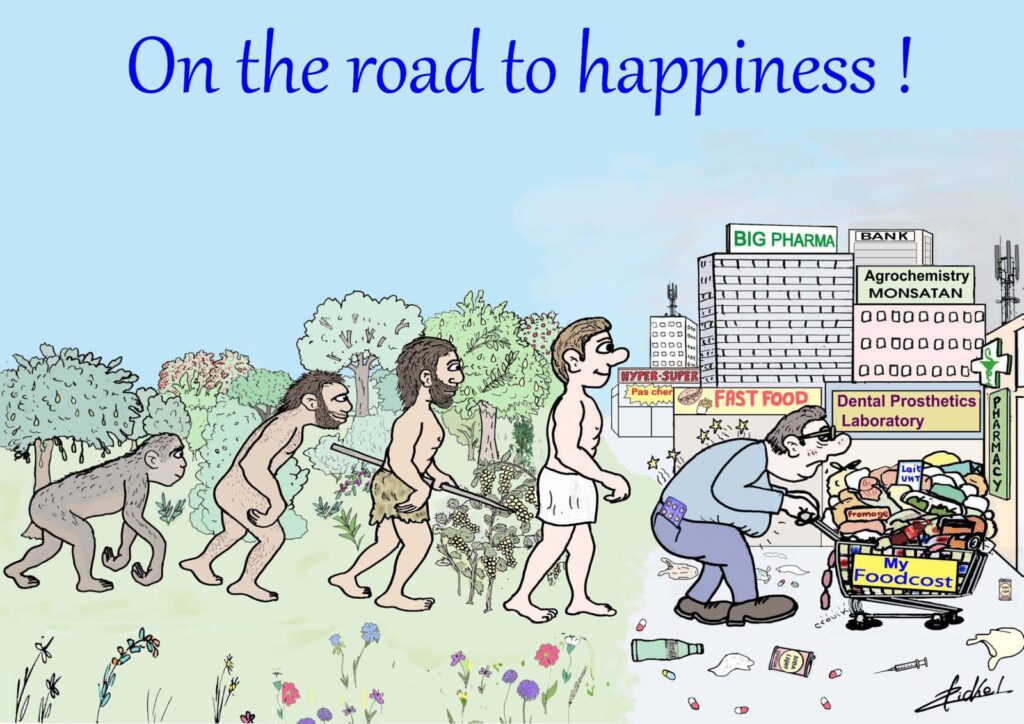
- about 2 million years ago, humans gradually transitioned from gatherers (95% fruits with some shoots and 5% small carnivorism) to gatherer-hunters. They significantly increased (first on carcass remains and then by inventing tools and hunting strategies) the meat portion of their diet.
- about 12,000 years ago, entering the Neolithic, humans began to eat grains and dairy products in addition to meat.
- about 50 years ago, humans started consuming industrially produced foods while some groups began to (re)eat primarily living plant-based foods, like our distant ancestors.
With the societal changes observed that seem inevitable in the short term, it is reasonable to believe that we are witnessing a civilizational change that, like in the past, will involve a significant change in our way of eating. Indeed, in the face of climate, ethical, health, and environmental issues related to the consumption of animal products,it feels as if life is no longer giving us a choice but to radically change our habits, with an unusual time requirement (about 30 years) compared to previous changes.
Everyone agrees that there is a problem with food. We eat too much meat or we eat too much in general! Food is too denatured! There are too many poisons in our diet! There is not enough fresh water and arable land on the planet! But concretely, what solutions are actually being proposed? Producing organic and local food, all at a low cost, while making some penny-pinching savings through shorter showers and putting a solar panel on the roof to charge an electric car !
And if these expedients do not yield the expected results, it will be the fault of others, of those who pollute or consume poorly, the fault of lobbies, CEOs, shareholders, governments, the crisis, etc.
The consequences of consuming animal products
This way of thinking has its own hidden benefits, placing us ipso facto in the ranks of victims, the good ones, while keeping us in the illusion that we have done our part. But, regarding food production for the future, is it really possible that only local and organic are the solution to our health and environmental problems?! The documentary Cowspiracy (watch by clicking here), summarized in the article “Impact of Living Nutrition on the Environment”, unequivocally shows that the answer is no!
The change that is not superficial and inefficient is the one that involves questioning the type of foods we consume, questioning the type of foods we physiologically need. And this touches on our deepest beliefs, those that revolve around the animal products we have consumed since humans have existed in their anatomically modern form. Is meat a survival food or is it necessary? Are we ready to reevaluate our beliefs? Are we ready to transmute the cultural markers and traditions that, for some, date back to the dawn of time? The question is superfluous just like our answer because life will not give us a choice, for the greater good of our individual and collective evolution!
What about ancestral medicines?
What I observe is that our resistance to change also manifests through our difficulties in stepping back from ancestral medicines like Hippocratic, Ayurvedic, or Chinese medicine. Yet, this questioning is necessary because everything in life evolves. The precepts, even if relevant, that are thousands of years old must be updated for our time. In a context of change like ours, the past can be a source of inspiration, but evolution and innovation must not be neglected lest we stiffen thought and practices.
Indeed, if, as centuries ago, we still lived in a non-polluted natural environment, without stress, in contact with the elements and with a physically active life, then a so-called “Mediterranean” diet, that is to say, essentially plant-based and raw (but not only) would be fully satisfactory. The blue zones (see this article) of the world where many healthy centenarians live are proof of this. If we lived in that same context, we would not be asking all these questions about lifestyle and ideal nutrition. All of this would flow naturally, and traditions would only need to repeat for the greater good of all.
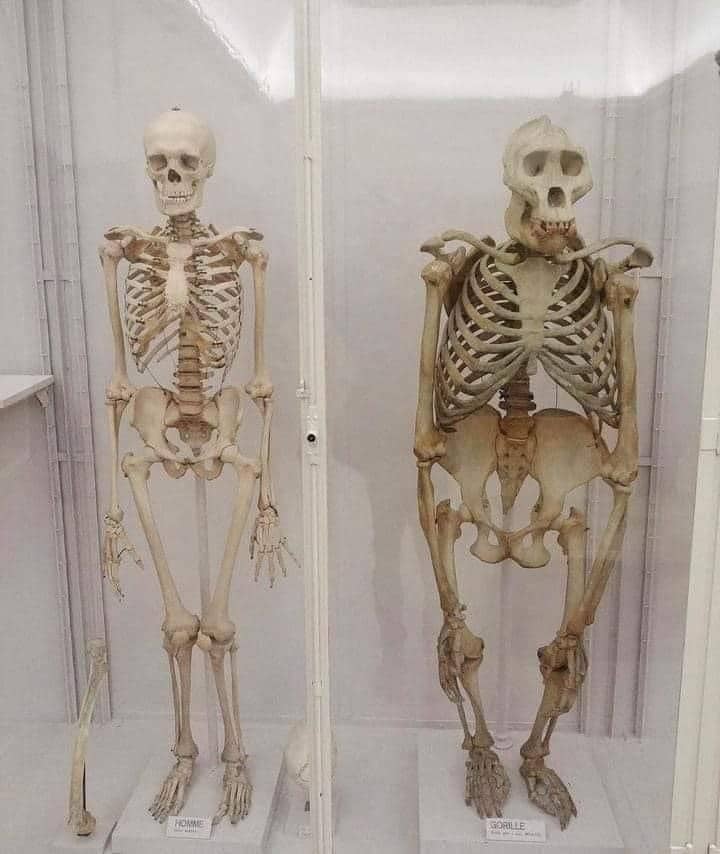

Simply, in our modern context with various sources of pollution, over-medication and vaccination, industrial food, and lack of physical activity, the ancestral health practices valid at one time prove, in my opinion, insufficient to regenerate our contemporary organisms that are devitalized, demineralized, and saturated with all kinds of toxins. Hence the necessity to evolve hygiene practices to meet the modern characteristics of our environment and individuals.
We are also at a time when we can no longer apply precepts without understanding them and without reconnecting to our feelings. For example, it is clear that Ayurvedic dietary advice that emphasizes cooked foods with very precise dietary protocols no longer makes sense for more and more people. All animals on this planet eat raw and thrive, so by what divine intervention should we cook our foods to be healthy? Why would it be contraindicated for some individuals to eat raw? Natural health practitioners do not seem to consider that naturopathic (or other) profiles are primarily profiles of diseases and not of people, and that these profiles can evolve with the improvement of the terrain.
Many ancestral practices (Hippocratic, Ayurvedic, and Chinese) seek balance through cures, gentle detoxes, fasting, phytotherapy, hydrotherapy, etc., which are effective but are clearly insufficient to treat modern pathologies, deeply regenerate organisms, or, more simply, to meet our full human potential. I believe that life always provides a solution when a problem arises. And according to my expertise, getting as close as possible to a plant-based and raw diet, using purgatives (see this article on purges), the regular practice of hormesis (see this article on the law of hormesis) and any other powerful practice can be seen as biohacking techniques, the antidotes to our modern ills.
Our only master & teacher: nature
The teacher of the hygienist practitioner is above all nature, and it shows us that no animal resorts to a dietitian or therapist to feed itself. How do they do it? It’s simple, they only eat raw and unblended foods that they can catch. First, they look at the food, then they smell it, and then, if necessary, they taste it. If the feeling is good, they eat until a natural sensory stop manifests. And sometimes they intentionally eat foods that make them sick when they feel the need to purge. Certainly, modern humans cannot return overnight to this ideal diet, but any sensible hygienist advice should guide towards a gradual return to this instinctive diet.
The ongoing civilizational changes also seem to involve the rejection of any form of authority that is supposed to explain how we should live and eat. Even if it is stamped Ayurveda or from another renowned school. Schools are stiffening and imbued with the limits and ego of those who created them. The great hygienist principles are there to provide directions and possibly a framework but in no case to be followed to the letter as if the truth could be found outside of us. The essence of the hygienist approach is to reconnect with our feelings and learn to give love (consciously) to our bodies.

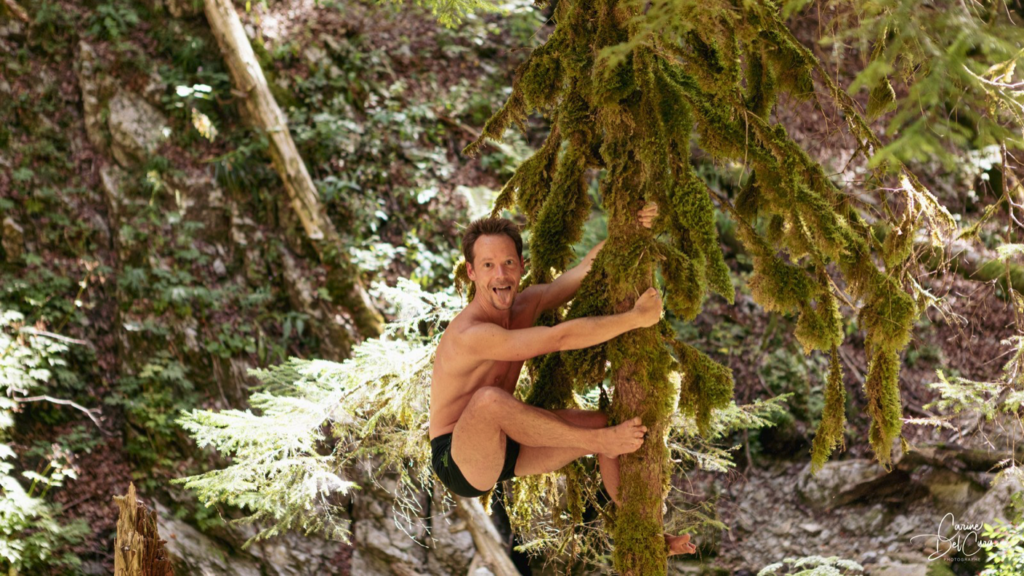
Isn’t it time to question these ancestral practices to evolve them and also see their blind spots? What about the rice cures recommended in Asia? We know very well that cooked starch is a source of glues (see this article on starches) in the body. Certainly, starch helps to buffer acidity, but for organisms saturated with toxins, when there are too many acids, it is better to expel them than to try to find balance by adding glues. Again, natural health practices must be adapted to our time. It is also legitimate to question the political motives and psychological consequences that a rice-based diet can have on a population where an unjust hierarchy with castes is desired. That said, naturopathy would benefit from drawing inspiration from Ayurveda, which adapts its hygienic recommendations according to the lifestyle (linked to its spiritual practices) of the person.
The evolution of the terrain through the ages and its consequences
For millennia (especially since the Neolithic), the terrain and constitution (in the naturopathic sense) of humans have been inexorably degrading. The more an organism accumulates toxins, the more its food cravings will become denatured, deviate its instinct (which will need to be re-educated), and attract an individual towards foods that poison them despite the consequences on their health. This mechanism, inherent to addictions, has led “culinary art” to “perfect” itself generation after generation until it offers highly toxic industrial food.
We arrive in the world with a toxic legacy bequeathed by our parents at conception and during pregnancy. Then, when we are not aware that functional diseases (those that cause bleeding, fever, diarrhea, vomiting, etc.) are triggered by the body to release toxins and cleanse the terrain, we will naturally flee the unpleasant sensations of detox through cooked food. Indeed, to escape the natural detox mechanism (which is inevitable when eating plant-based and raw), it is necessary to introduce foods that will bring toxins or slow down the immune system. Thus, the body will switch from detox mode to “intox” mode during which it stores unwanted toxins in the tissues.
The time to move from intox to detox
Thus, generation after generation, individuals are born (generally) with an increasingly heavy toxic legacy and increasingly degraded health. As Leo Tolstoy wrote in Anna Karenina:“There are no conditions to which man cannot become accustomed, especially if he sees that all those around him live in the same way.” The only way to reverse this trend is, first and foremost, to become aware of this unhealthy mechanism that inexorably pushes us, over generations, to eat more and more processed food, and then to reverse the tide by gradually entering a conscious detoxification process of the organism. Having strayed too far from our physiological needs, I believe that this detox and regeneration mechanism, first induced by isolated individuals, will gradually gain the entire population.
We are therefore living in a great time of cleansing where the time has come to shed both layers of toxins and conditioning, unhealthy habits, or limiting beliefs, to move towards a freer and more conscious humanity. I believe that this is the goal of a Holistic and Humanist Hygiene (see this article on the new hygiene) to provide knowledge and know-how to support this societal change from intox to detox. The subtlety of this art, the 3H, consists of finding the right measure, the right rhythm, which will vary from one individual to another, and from one period to another. Wanting to go faster than the music will be counterproductive (see this article) and listening to oneself will always be essential to avoid getting lost.
On this path that will take several generations, it will be crucial to keep in mind that what matters is not where we are but where we are going. Because if taking care of one’s body is more necessary than ever, it will never be an end in itself. Because, in the end, isn’t it always Love that heals?