“As problematic as the synthetic chemical substances present in your environment and food may be, they are not the main cause of cancer.”
T. Colin Campbell “The Campbell Report”
I started my dietary transition about fifteen years ago to move towards an exclusively local and organic diet. A few years later, I embarked on the adventure of food autonomy by producing almost half of my food through a vegetable garden, an orchard, and poultry. And by cooking everything at home.
At the same time, my lifestyle was impeccable (according to commonly accepted criteria) with a physical outdoor job, sports, country living, and no stress. I ate nothing industrial, no soda, no alcohol, no cold cuts, but plenty of fruits, vegetables, and only homemade dishes with organic products. Yet, it was during this time that my health deteriorated. I had allergies to cat hair, pollen, sciatica, skin problems, and sweating issues. This showed me that organic, local, and homemade does not prevent illness.
I experimented with this dietary mode for years, which I considered top-notch until an experience changed my life (see article “Why I Changed My Diet?”) and I discovered the principles of Living Nutrition.
Since I have been eating exclusively living foods (see article “The Origins of Living Nutrition”) my aforementioned health problems have almost all disappeared, and my relationship with food has evolved. I no longer see it merely as a means to fuel my body but also as a way to detoxify and regenerate it. Gradually, I observed that Living Nutrition transformed me on all levels: physical, mental, emotional, and spiritual. Thanks to it, I feel more aware and connected to my intuition than ever, which has greatly contributed to improving my quality of life and bringing me closer to the state of Optimal Health (see article “Hygienism: Optimal Health”).
My relationship with taste pleasure has also transformed with Living Nutrition. The food addiction caused by refined sugars, fats & salts, and Maillard molecules has been replaced by the indescribable joy of listening to my body and giving it what it truly needs. This is a unique experience that can only be understood by living it and transcends the pleasures of traditional cooking.
Feeding exclusively on living foods is such an incomparable experience of regeneration and reconnection to nature and the Self that any backward step is unthinkable. This revolutionary experience led me to consume only organic and local products.
Reasons why I no longer consume exclusively organic:
- When transitioning to Living Nutrition, one buys much more fruits and vegetables than before, which significantly impacts the budget if the fruits and vegetables are organic. One can end up with a very high food budget (200 euros per person per week, or more). The conclusion is clear: either we also buy foods from conventional agriculture, or we start eating inexpensive cooked foods like cereals and legumes again.
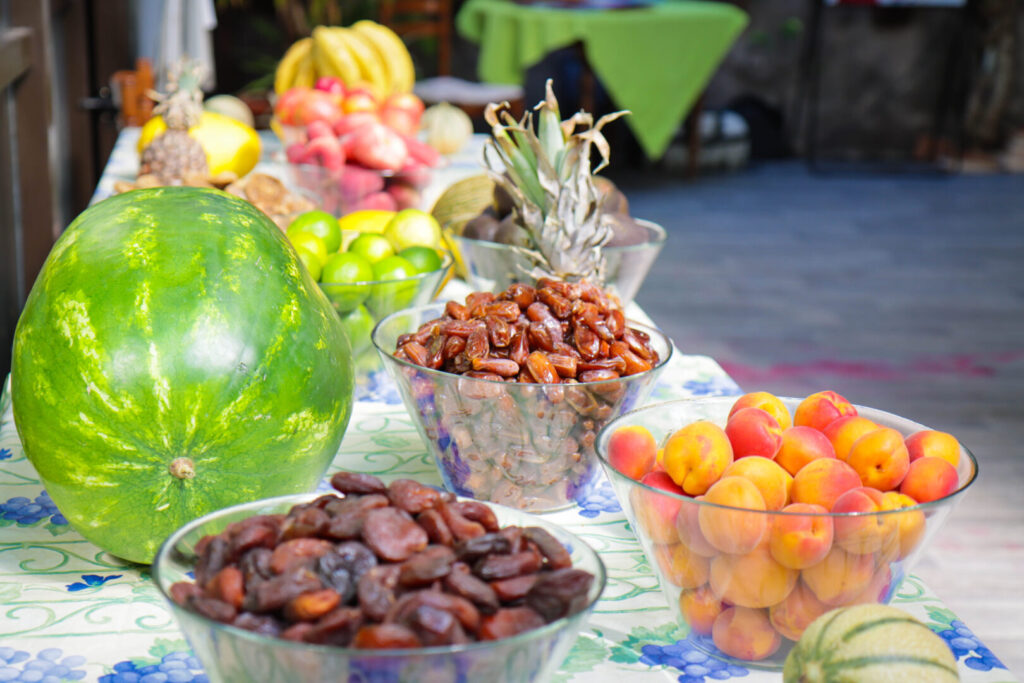
- Most exotic fruits like avocados, mangoes, pineapples, etc., are generally not treated, except sometimes for preservation, which is why putting an organic label on these foods often makes no sense. Indeed, exotic fruit trees are naturally robust, so they require little or no treatment, unlike those from our temperate regions, which are remnants of the last glaciation and must be grafted to produce sweet fruits.
- Some fruits from conventional agriculture are sometimes of equivalent quality to organic. Simply because some producers practice organic farming without having the label to avoid administrative constraints.
- Moreover, the value of the organic label should be relativized due to all the harmful treatments allowed and all the exemptions granted for the use of phytosanitary products. Not to mention organic products coming from outside the European Union, for which there is no control.
- According to studies conducted by American doctor Norman Walker, who wrote “Fresh Fruit and Vegetable Juices”, pesticides that are hydrophobic mostly cling to insoluble fibers (made of cellulose that we do not digest) and are therefore not absorbed by the body, provided that these plants are consumed raw.
- I believe that the main poisons impacting health are the acids and glues generated by cooked or animal-derived foods (see article “Cleansing, the keystone of hygiene!”) and not pesticides. In light of the previous considerations, cooked or animal-derived foods sold as organic are, in my view, more harmful to health than fruits and vegetables from conventional agriculture.
In conclusion
Experience shows that with Living Nutrition, even if the fruits and vegetables are not organic, the body regenerates. This is not the case with only organic but a large share of cooked foods. Furthermore, the organic market has become a lucrative business (especially for large retailers who make larger margins than with conventionally produced foods) that drives up prices without necessarily ensuring consumers have quality products. Even if organic is almost always better (at all levels) than conventional, I do not think it is the future. The ideal is to eliminate intermediaries and go directly to the producer, or to use ethical intermediaries. This is the best way to benefit from a reasonable price and to be informed about the agricultural methods used. I am convinced that these methods will evolve willingly or by force towards “organic” practices, whether a label is present or not for verification.

Reasons why I no longer exclusively prioritize local:
- When one understands and feels how much we are made to primarily eat fruits, every meal becomes a great celebration where pleasure and health finally align. After years of deprivation of living foods, our body then demands the best fruits. And it is often the exotic fruits that we appreciate the most since we are made to live in the tropics. There is then a dilemma between listening to the needs of my body (which has been quite mistreated until now) and limiting the transport of goods.
- If one confines oneself (when living in a temperate environment) to eating only local fruits (like apples, pears, and oranges), one will quickly feel frustrated. Already, the dietary transition to plant-based and living is a challenge in itself, and experience shows that limiting oneself to local will lead to abandoning Living Nutrition.
- I do not believe that the increase in carbon dioxide (and certain greenhouse gases) is responsible for global warming. Many studies show that it is linked to an increase in water vapor concentration in the atmosphere, which fluctuates chaotically. Certainly, this does not prevent it from being preferable to limit travel to reduce pollution, but not because of carbon dioxide. Moreover, the consumption of animal products is the main cause, far ahead of transportation, of environmental degradation (see article “The impact of living food on the environment”).
In conclusion: Taking care of one’s body by feeding exclusively on living foods leads to a profound transformation of the being. This never leaves those around indifferent, who can only question themselves and gradually be led to reconsider their beliefs about food. This impact allows those who are close to us to gradually eat healthier, feel better physically, and consume fewer animal products (the consumption of which jeopardizes the biosphere). We then realize that eating living, even if it means not eating only local, brings more positive effects than negative ones due to the revolution it brings around us.
How do I see the future?
I believe that the priority at the moment is to eat as much living food as possible, thanks to this abundance of fruits on the shelves, in order to regenerate and learn to live in abundance. Even if it means not always eating organic, local, and seasonal! It is not certain that we will be able to enjoy this abundance of fruits for much longer, and local food may become a constraint. It will then be more difficult to initiate a dietary transition in a context of restriction.
What we observe year after year when eating living is that the body becomes less and less demanding and that we decrease our caloric intake. It then becomes easier and easier to be satisfied with a less diverse and local diet.
Finally, on a global scale, we have all the technological means to build greenhouses in all latitudes and to develop varieties of plants and trees that adapt to temperate climates. It is only the will that is lacking to develop these projects, and this will persist as long as humanity believes that fruits and vegetables are there to decorate plates.
It is therefore entirely possible to eat living, organic, and local all over the planet (or almost), it is just a matter of will. And while waiting for this to happen, it is important to remember three notions:
- It is the vitamins, minerals, and phytoactive elements present in fruits and vegetables that give them their colors and pleasant tastes. These nutrients can only develop if the plant grows under correct conditions without being overly exposed to fertilizers and pesticides. Therefore, if the food is good, it is nourishing and generally beneficial even if it is not organic. That is why I eat “good” before eating “organic.”
- If a fruit has grown, it is because it is in season somewhere.
- If we do good to our body (with living foods regardless of their origin), we necessarily do good to the planet. We are part of it, and what is good for one is good for the other…