
“Fresh fruit juices purify the body, fresh vegetable juices restore it.”
Dr. Norman Walker
Natural sugar is the primary source of energy for living beings
We all need energy to live, to ensure our biological functions, to defend ourselves from aggressions, to regenerate, etc., and the most efficient source of energy for our cells is the sugar found unprocessed in nature. Even though the body can produce energy from lipids (as is the case during fasting), this backup route greatly burdens digestion and is energy costly, which is why it is not optimal for the body (see the article on the keto-carnivore diet).
If we do not primarily derive our energy from the simple sugars in fruits, we will seek it from starches (glue producers, see the article on the harms of cooking) or from animal products (which contain stress hormones that overstimulate the body, giving a false sense of energy, which atrophies the adrenal glands, see the article on the keto-carnivore diet) or from stimulants, which exhaust the nervous system and lead to burnout, such as refined sugar (found in sodas, cakes, jams (including “homemade”), etc.), coffee, tea, alcohol, etc. These three other sources of secondary energy are all addictive, acidifying, and harmful.
In the 1970s, the famous hygienist Herbert Shelton already lamented this fear of the natural sugar in fruits, maliciously instilled by lobbies (agri-food and pharmaceutical), which spreads even to the benches of naturopathy schools due to a lack of practice in Living Nutrition and a loss of common sense. Discrediting the safety of fruits, this preferred food for our body, is a way to deprive consumers of access to information that would allow them to consciously choose a diet that provides vitality, joy, and health. Why deprive us of this crucial information for our health? Simply because those who have the power to publish “studies” and inform us on a large scale about nutrition have more interest in having consumers buy cereals, animal products, and industrial food rather than fruits & vegetables. Producing false studies to stifle those that are relevant is a well-honed strategy that was already at work in the 1950s regarding the dangers of tobacco.
Conflicts of interest that blur the lines
Even though there are clinics (like those of Gabriel Cousens and Dr. Robert Morse in the USA) that treat diabetics with Living Nutrition (favoring fruits), false studies (motivated by conflicts of interest) mislead.
"At one time, fructose was recommended for diabetics because fructose has a low impact on blood glucose levels. Relying on this characteristic, a scientific opinion from the EFSA led the European Union to authorize a health claim on fructose in 2013. But fructose's reputation then deteriorated. Simone Lemieux from the Institute of Nutraceuticals and Functional Foods (INAF) states that 'when consumed in large quantities, fructose increases triglyceride levels in the blood, which is a factor for cardiovascular disease and insulin resistance.'"
Wikipedia


It is important to understand that all studies claiming that fructose is dangerous for health are conducted on rats injected with large amounts of pure fructose. This is as absurd as injecting pure oxygen into humans (which is deadly) and concluding that this gas is toxic! That is why pure fructose found in corn syrup (which is heated and contains no fiber) is not comparable to that found in fruits.
These absurd rumors about fructose motivated one of my friends, Hervé Deschamps, to conduct experiments on his blood sugar. Using a sensor (FreeStyle brand), he monitored the evolution of his blood sugar over several days through meals and physical activity.
Fresh fruit juice VS pasteurized fruit juice
Experiment #1: With one liter of fresh apple juice (13 Gala apples processed in the extractor)
Contrary to what is often heard, including in the field of naturopathy, fresh fruit juices are the most vitalizing and detoxifying foods (Read Robert Morse “The Miracle of Detox” and Norman Walker “Fresh Fruit and Vegetable Juices” for more information) there are. Fresh fruit juices are even successfully used in some clinics (like Dr. Morse’s in the USA) to regenerate the nervous system (which is very energy-hungry) and revitalize exhausted individuals. Even though it may seem counterintuitive, fresh fruit juices do not destabilize blood sugar (meaning it remains between 0.7 and 1.6 g/l, a healthy range). This is for at least three reasons:
- Juices (of fruits or vegetables) always contain a quantity of soluble and insoluble fibers that slow down the absorption of sugars and alert the liver that fructose is coming so that it prepares to receive it.
- When a food is raw, the body metabolizes, assimilates, and eliminates nutrients, various salts, minerals, and phyto-active principles much more easily. Furthermore, according to some sources (see Georgia Knap, a self-taught genius known for her rejuvenation method; unfortunately there is no English version of this Wikipedia page), raw fruits would contain a natural insulin.
- Fruits mainly contain fructose, which is metabolized by the liver into lactate (25%), glycogen (15%), triglyceride (10%), and glucose (50%) depending on the body’s needs (see diagram 1). Moreover, the regulation of blood sugar (via insulin) is much more effective when sugar is not mixed with fats.
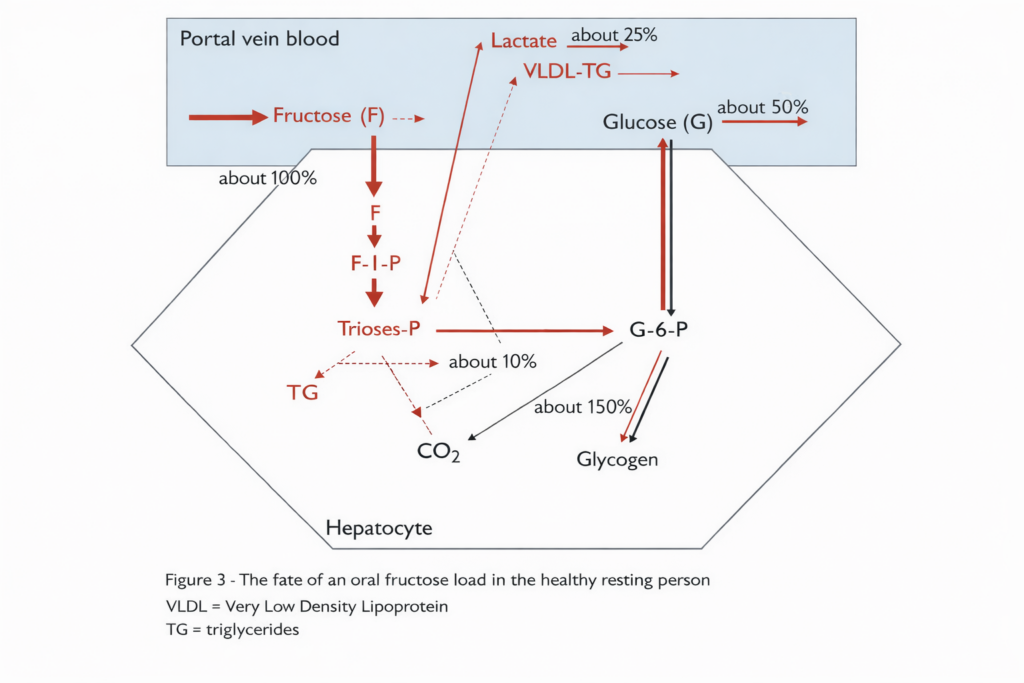
Diagram 1 can be found in this article on fructose published on Planet Vie website. (Translation note: this link leads to a website in French. To read it in English or another language, simply copy the URL and paste it into Google Translate https://translate.google.com/?sl=fr&tl=it&op=translate)
Anyone can verify this next experiment for themselves: drink a liter of fresh fruit juice and see if you experience hypoglycemia. For if there is hyperglycemia, it is necessarily followed by reactive hypoglycemia. As for the blood sugar spike, it is normal whenever one consumes any food that contains sugar, and this is not a problem. This is confirmed by experiment #1 conducted by Hervé, during which he drank freshly pressed juice from 13 Gala apples in just 6 minutes on an empty stomach in the morning. After this fruit meal, Hervé remained physically inactive (tidying his house and working on the computer) for 2 hours during which he felt good.
As can be seen in diagram 2, there is no problematic evolution of blood sugar, and the sugar shot is managed in just one hour.

Experiment #2: With a pasteurized apple juice from Carrefour
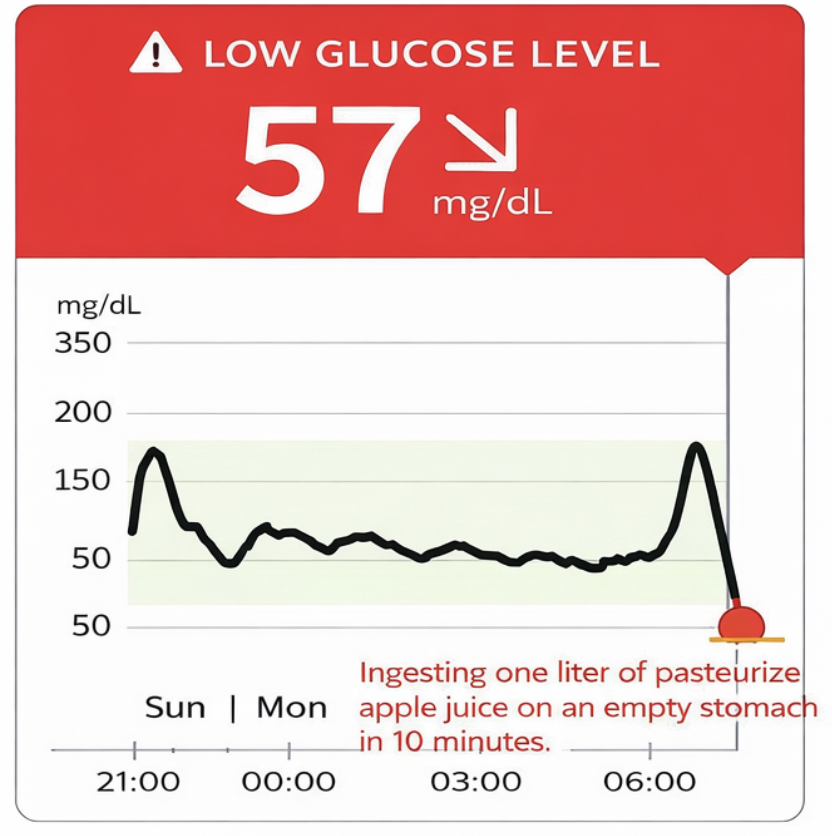
Here is the same experiment as #1 but with one liter of pasteurized apple juice from Carrefour.
After consuming one liter of pasteurized apple juice, Hervé remained physically inactive (as in experiment #1) for 2 hours during which he felt nauseous. In diagram 3, it can be observed that this time there was hyperglycemia (> 1.8 g/l) followed by reactive hypoglycemia.
The difference in glycemic response between experiments #1 & #2 illustrates that a living (or raw) food is much better metabolized and digested than a dead (or cooked) food. More specifically: the filtration of commercial apple juice removes almost all soluble and insoluble fibers (which do remain with juice obtained from the extractor, even if it is then filtered through a strainer), giving it a brighter color but preventing the liver from being alerted that fructose is coming (this is one of the roles of soluble fibers), moreover faster than when the juice still contains fibers. Furthermore, the loss of chemical energy, the destruction of digestive enzymes (naturally contained in fresh food), and the chemical reactions induced by heat (during pasteurization, the juice is subjected to temperatures between 70 and 100 °C) complicate and slow down the transformation of fructose into lactate, glycogen, triglyceride, and glucose that occurs in liver cells (see diagram 1). Digestion is then slower (2 hours instead of 1 hour), less well managed (appearance of hyper and hypoglycemia), and energy costly (related to the destruction of enzymes and the yo-yo effect of blood sugar that fatigues the pancreas), all with undesirable side effects (nausea).
The digestive incompatibility between carbohydrates and lipids
Experiment #3: Raw food meal with mixed apples and nuts (raw crumble recipe)
According to some American diabetes specialists (see the film “What the Health?”) it is not sugar (refined or not) that is the main culprit of the type 2 diabetes epidemic but the consumption of animal fats that disrupt the absorption of sugars. Indeed, animal fats have the ability to bind to insulin receptors on cells, preventing glucose from being absorbed inside them. These bad fats would therefore indirectly stimulate the pancreas to produce more insulin than necessary and would be the underlying mechanism for blood sugar disorders. Furthermore, a particularly indigestible food combination (see “Food Compatibility” by Désiré Mérien), and yet common in our eating habits, is the consumption of sugars and fats during the same meal (like a dish with pasta and cheese, for example).
These two unhealthy habits mentioned above (animal fats and bad food combinations) cause repeated hyper and hypoglycemia, which, over time, fatigues the pancreas and promotes type 2 diabetes.
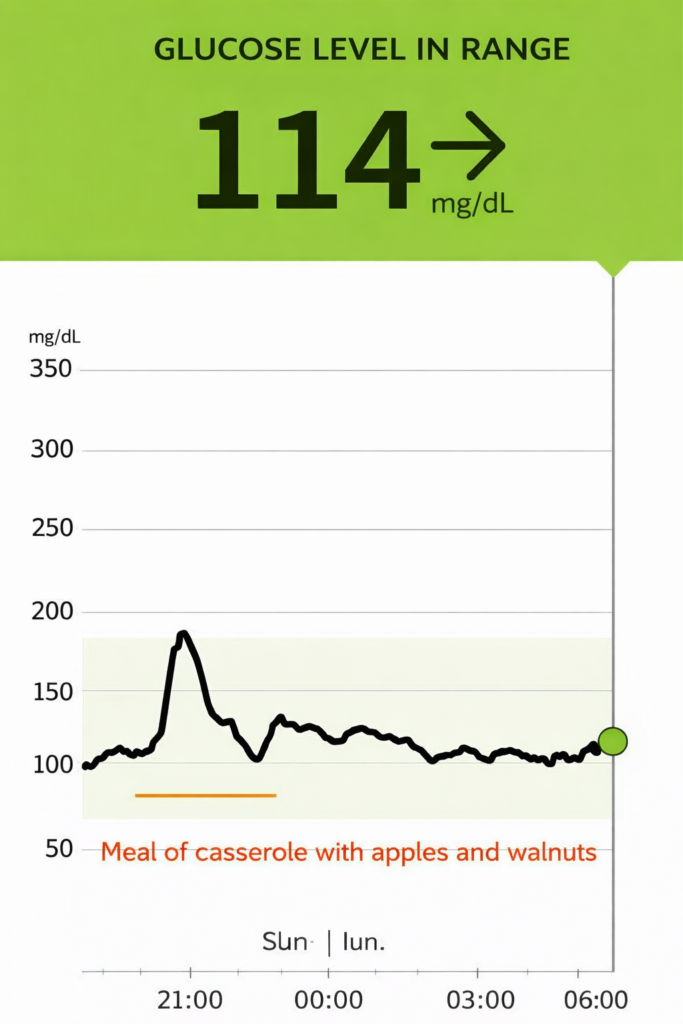
A theory validated by this experiment #3 where it is observed that the digestion of sugars is more complicated. Hervé is close to hyperglycemia (after consuming the equivalent of only two apples) and digestion takes 3 hours compared to 1 hour for the digestion of one liter of fresh apple juice.
Questions you may be asking
Are vegetable fats incompatible with sugars?
Yes, sugars cannot be well digested and assimilated in the presence of lipids (of animal or vegetable origin). Read this article on “What are our lipid needs?” for more information.
Why compare a raw food meal (experiment 3) with fruit juice (experiment 1)?
Simply to show that the digestive system manages the influx of sugar from 13 apples (especially in juice form) better than the mixture of just two apples mixed with fat (nuts in this case in this experiment).
Why conduct experiments 1 & 2 on fruit juices and not on fruits directly?
Because some people deprive themselves of the benefits (detoxifying and vitalizing) of fruit juices for fear of ingesting too much sugar too quickly. However, if blood sugar is well regulated by the body with fruit juices, it will be even more so with whole fruits.
For more information
- The article “What to think about sugar in Living Nutrition?”
- The article “What to think about starches?”
- “The Detox Miracle Sourcebook: Raw Foods and Herbs for Complete Cellular Regeneration”, by Dr. Robert Morse
- “Fresh Vegetable and Fruit Juices” by Norman W. Walker