Recently, through two videos that were shared with me, I was surprised to learn that some people consider humans to be neither frugivores nor even omnivores, but carnivores. One of them is extracted from a so-called ‘integrative’ medicine congress, so I listened carefully to the arguments presented that would suggest that humans are physiologically designed for a keto-carnivore diet (that is, based on meats and fats). I respond point by point to these arguments in this article.
Here are the videos in question:
My surprise lies in the fact that the phylogenetic classification of humans undeniably places us among primates that are part of the great ape family, all of which are frugivorous species. Even though humans have gradually anatomically differentiated from other anthropoids over the past two million years, we have retained organs and a digestive system very similar to theirs, as can be verified in the comparative study below, made famous by Herbert Shelton, which is attributed to Dr. Richard Lehne and Swiss Dr. Bircher-Benner over a century ago.

Observations that have been confirmed for several centuries by anatomists, anthropologists, and naturalists.
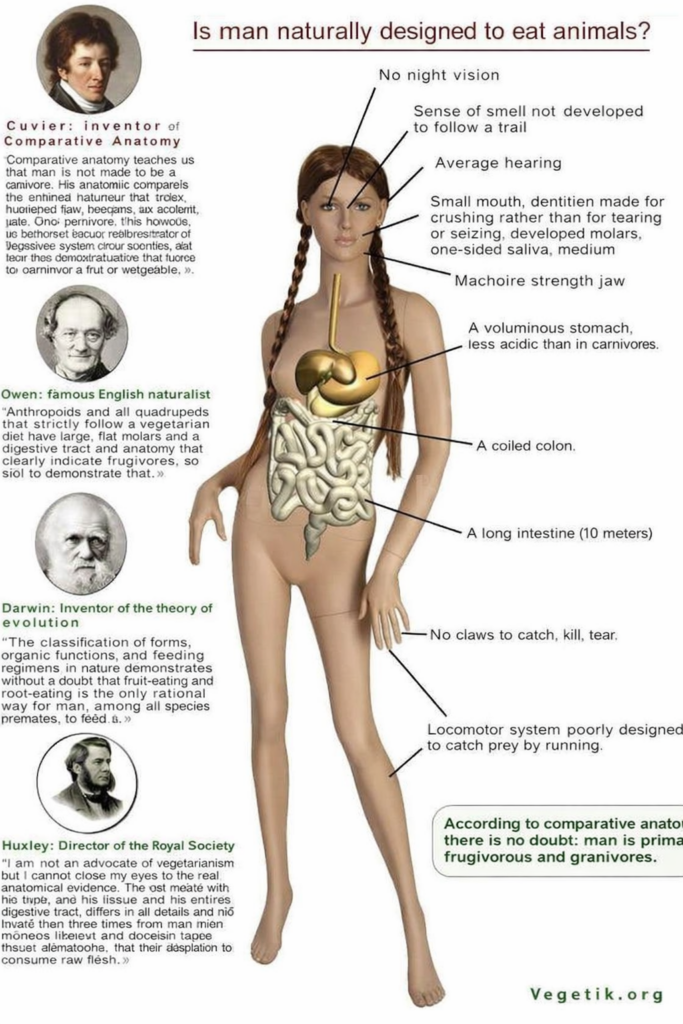
I did not think that a debate could still take place on this subject; however, there are a few sites (like this one) (Translation note: this link leads to a website in French. To read it in English or another language, simply copy the URL and paste it into Google Translate https://translate.google.com/?sl=fr&tl=it&op=translate) that challenge some data contained in this diagram. It is true that some points are debatable, such as the true length of the human intestine, which is a complex data to evaluate and has been the subject of controversies for over a century, as can be verified in publications like “.Observations upon the growth and length of the human intestine”, American Journal of Anatomy, 34(2), 227–284, by Bryant, J. (1924).
That said, even if it is always possible to quibble over parameters that everyone cannot verify for themselves, like the length of our intestine, the acidity of gastric juices, the nature of our intestinal flora, etc., it is evident that we are not capable of catching animals with our bare hands and that, even if we could, we would not be able, with our dentition, to tear their skin to eat their flesh. Moreover, the majority of us would be repulsed by the idea of killing an animal with our own hands. This is what common sense and observation tell us. For these reasons, our regular consumption of animal proteins has depended, since its origins, on technology for hunting (weapons), skinning and cutting meat (flint), and fire to preserve meat or rid it of parasites.
The idea that humans are frugivores is therefore not new. This makes sense since before Homo sapiens sapiens appeared, our ancestors (non-human) were frugivorous for 63 million years. It is only in the last two million years that humans began to consume meat, hence the necessary appearance of adaptations to digest this type of food. However, this does not mean that we have become carnivores, nor does it mean that we cannot return to our preferred diet: fruits.
To learn more about dietary changes during evolution, read the article “The Origins of Living Nutrition.”
To read other strong arguments in favor of plant-based nutrition, read the article “What is the ideal % of living nutrition for everyone”, paragraph: “Why do I no longer consume animal products at all”.
A revealing anatomical fact about our true nature, frugivore or carnivore, seems not to be questioned by proponents of the human carnivorism thesis. It is the remarkable fact that, unlike carnivores, we do not secrete uricase, an important enzyme that transforms uric acid produced during the digestion of animal proteins into a more soluble and less corrosive substance: allantoin.
“Uricase is the final catalyst in the degradation of purines in non-primate mammals and lower primates, but the expression of uricase has been lost in humans and higher primates during evolution. Uricases directly degrade relatively insoluble uric acid by catalyzing its conversion into highly soluble allantoin.” xPharm
Click here to learn more about this topic (Translation note: this link leads to a website in French. To read it in English or another language, simply copy the URL and paste it into Google Translate https://translate.google.com/?sl=fr&tl=it&op=translate).
Translation note: the second video is in French, but you can activate YouTube’s auto-generated subtitles in English while we work on providing a dedicated English version.
Beyond anatomical, anthropological & ideological arguments, let’s return to the facts. Experience shows that some humans, like the Inuit, have adapted to a carnivorous diet rich in fats. In a context, let’s remember, with a lot of hormesis, periods of fasting, the consumption of berries in summer (acidic fruits help uric acid exit tissues) and a reduced life expectancy (around sixty years) compared to blue zones (around a hundred years) where the diet is primarily vegetarian.
In reality, if one eats raw meat as well as all parts of the animal (skin, bones, blood, guts, and viscera included, like a carnivore), or by aging the meat, humans can find everything they need in terms of micro and macronutrients for physical development. Just as humans can also develop with an exclusively plant-based diet. But that is not the question.
This is where etymology becomes interesting, as can be read in the “Zen Detox Aromatic Cure” volume 1 by Nelly Grosjean and Miguel Barthéléry:
“Food, from alere = to nourish and mentis = mind… food is literally the nourishment of the mind; nutrition, from nutrire = to grow. Let’s talk about ‘feeding’ rather than ‘nutrition’! To feed is to unconsciously evoke the idea that we do more than replace matter; we (in)form the mind. So let’s talk about natural and living nutrition and leave nutrition to nutritionists!”
The real question is rather about what matter we wish to inform our minds with. With fruits that plants produce in a spirit of cooperation (their flesh is sweet to entice animals to consume them, and they, in return, disperse the seeds)? Or with the flesh of animals killed in hunting or tortured in slaughterhouses (not to mention their deplorable living conditions and the disastrous consequences on the environment)?
To learn more, read the article “The Impact of Living Nutrition on the Environment”.
Some spiritual currents that I adhere to consider that we create our reality based on our beliefs. According to this perspective on our existence, if we think that life is a hard struggle where the law of the strongest and the craftiest prevails (a viewpoint serving war, hierarchies, and capitalism), then we will need meat to maintain such an energetic structure and we will adopt a warrior attitude. On the other hand, if we believe that all forms of life are love by essence (before fears & dogmas parasitize it) and that nature has given us everything, then we will use our hands not to kill but to pick fruits and embrace life without fears.
That is why one cannot radically change their diet without radically changing their way of seeing the world. Despite my beliefs on the subject, I took the time to watch the two videos that were sent to me to demystify them:


In video 1 (“Metabolic Psychiatry”) :
- It is said that the digestion of sugars produces many waste products. In reality, all macronutrients (carbohydrates, proteins, and lipids) produce waste during their digestion and metabolism. Carbohydrates generate pyruvic acid, lactic acid, and carbon dioxide (wastes that the body knows how to recycle, it just needs to be normally oxygenated and mineralized). Proteins generate uric acid, phosphoric acid, sulfuric acid, ammonia, purines, pyrimidines, and carbon dioxide (our body has difficulties eliminating them because our kidneys and liver are not designed for us to consume them in quantity), and lipids generate ketones (which in excess cause ketoacidosis) and carbon dioxide. It is also not mentioned that unused sugars are stored as triglycerides, thus as fats.
- It is said that ketones (from fat digestion) enter cells freely but it is not mentioned that fructose (if we consume fruits and not starches) does the same without needing insulin. Moreover, type 2 diabetes is not cured with a ketogenic diet, whereas it is possible with living nutrition. To learn more, read the article “What to Think About Sugar in Living Nutrition?”
- It is said that muscles are there to make us run from a tiger but not that they can also serve us to move to pick fruits. Athlete Leo Urban wonderfully shows that we can still move like a monkey. We can see how similar we still are to them.
- It is said that the yield of lipids is higher than the yield of carbohydrates for producing energy (ATP). One just needs to test for oneself to verify that one has more energy when consuming primarily sugar than when consuming fat. Furthermore, the ATP production process presented does not take into account the recycling processes of lactic acid (Cori cycle) resulting from sugar degradation. Additionally, the calculation of this yield does not take into account the rarity of lipids in nature compared to the presence of carbohydrates, not to mention the energy cost that lipid production entails for a plant or an animal.
- It is said that cholesterol is vital for producing steroid hormones and that it is found in abundance in saturated fats (from red meats, etc.) but it is not mentioned that cholesterol levels are already too high, nor that the body is capable of producing its own cholesterol (from both fats AND sugars). Moreover, one of the precursors of cholesterol is mevalonic acid which is obtained from sugar metabolism.
- It is said that anthropologists are unanimous: humans are carnivores (facultative omnivores). This is false! The previous diagrams actually show the opposite. It is also said that genetic mutations take millions of years to create metabolic changes but it is not mentioned that for 63 million years we were frugivores compared to 2 million years of opportunism with animal products. Humans have remained anthropoids throughout evolution, like all great apes.
- What is said about the necessity of consuming exogenous B12 is simply false. To learn more, read the article “Animal Proteins and B12 Vitamins”.
- It is not mentioned that the human body can synthesize vitamin A from beta-carotene found in plants.
- The claims about the supposed superiority of animal vitamins are unfounded and unsupported.
- It is said that diarrhea is a symptom of irritable bowel syndrome whereas it is primarily an effective and vital means for the body to detoxify.
In video 2 (“Plant Toxins”):
- It is said that plants produce toxins to protect themselves from predators. Except that in the case of fruits, plants produce appetizing ones so that animals consume them and spread their seeds (which only transit through the digestive system). As for the anti-nutrients in seeds, grains, and legumes, I discuss them extensively in this article on starches and that is why I do not recommend their consumption either.
- The principle of Paracelsus is cited: “The dose makes the poison”. Very true! Except that it is not specified how to know when we exceed this famous limit dose. Yet it is very simple when one knows the alliesthetic properties of raw foods. The sensory stop manifests naturally to tell us when to stop eating a food. We thus know, for example, whether it is wise to remove the skin of a fruit or if we can eat it. One just has to listen to their feelings. To learn more: read the article on “Sensory Nutrition”. Furthermore, Dr. Michael Greger, among others, has shown that certain substances called toxic, such as lectins and phytates (found in seeds), are beneficial in small amounts (Paracelsus principle!). To learn more, read the article: “How to Choose Wild Plants?”
- It is said that the molecules found in medications are the same molecules found in nature. This is false! They are isomers of the original molecule (prohibition of patenting life) that are isolated in a medication while in the plant the active molecule acts in synergy with hundreds of other compounds. To learn more, read the article on “Shamanic Purges“, paragraph: “Medical science, a pale copy of nature.”
- It is said that cooking detoxifies food. This is false! Cooking creates toxic compounds and prevents the body from manifesting the sensory stop. To learn more: read the article on “The Dangers of Cooking”.
- It is said that plants are emergency foods. The experience of sensory nutrition shows, on the contrary, that the sensory stop is weak with animal products and high with plants because the acuity of the stop that nature has shaped for us is directly related to the rarity or abundance of a food in our environment. To learn more: read the article on “Sensory Nutrition”.
- It is said that the oxalates contained in many plants are poisons causing kidney stones and inflammation. This is false! Let’s set the record straight: statistically, it is the heavy consumers of animal proteins who suffer the most from kidney stones, not the heavy eaters of spinach! So why are the kidney stones that form in people consuming a large proportion of animal proteins primarily composed of calcium oxalate? First, the precipitation between oxalate (which the body can produce on its own even without dietary intake) and calcium (an alkaline mineral that the body releases to buffer excess acidity) is only possible in an acidified environment (typically that of animal protein eaters) while urine and blood are neutral in the context of a living and plant-based diet. Furthermore, these calcium oxalate crystals due to acidosis actually serve to help the body eliminate excess acidity (Translation note: this link leads to a website in French. To read it in English or another language, simply copy the URL and paste it into Google Translate https://translate.google.com/?sl=fr&tl=it&op=translate). This explains why, after a crisis generally attributed to oxalates, the joints are more flexible than before; they have simply done their detox job! This is why meat lovers sometimes have difficulty consuming plants in quantity because they, by their nature, help clean the acidic digestion residues of meat while rebalancing the intestinal flora (made pathogenic by the putrefaction of animal meat remaining 24 to 48 hours in the digestive system). Just as they find it more difficult to fast than others (which I have observed during the weeks of Fasting and Trekking that I have organized for 5 years) for reasons of detox and withdrawal from animal flesh.
Even though I am not a staunch supporter of scientific studies (as many of them are biased), it is still important to point out that there is no evidence showing that a carnivorous or keto-carnivorous diet can reverse the leading cause of mortality in the world, namely cardiovascular diseases. In fact, it is quite the opposite. As a reminder, it was internationally noted that during World War II there was a significant decline in all cardiovascular diseases even though the period was stressful and the consumption of animal proteins was much lower than before.
Moreover, there are thousands of studies showing that a vegan diet can reverse the top 15 causes of death in the world. In this regard, I invite you to read “The Detox Miracle Sourcebook: Raw Foods and Herbs for Complete Cellular Regeneration”, by Dr. Robert Morse, “The China Study. The Most Comprehensive Study of Nutrition Ever Conducted and the Startling Implications for Diet, Weight Loss, and Long-Term Health” , by T. Colin Campbell & Thomas M. Campbell II and “The 80/10/10 Diet” by Dr. Graham Douglas.
In the meantime, here are two more serious videos (above) on the topics previously discussed. The first, by Dr. Michael Greger (“How Not to Die?”), who asserts, with evidence, that the best diet for humans is a vegan diet. The second, by Dr. Brooke Goldner, discusses the link between oxalates and kidney stones.
In conclusion
Naturopathy in France unhesitatingly recognizes that humans are frugivores, but there is still no consensus in this field on whether it is preferable or not to completely stop consuming animal proteins. I share the opinion of Dr. Michael Greger who speaks of moderation (implying eating animal products in moderation) as the choice to hit oneself with a small hammer rather than a big one (sic).
This indecision comes from the fact that great apes, from whom we draw a lot to determine what is physiological or not for humans, themselves consume a bit of meat and insects. Some tribes of monkeys consume more than others, and I leave you to discover how meat consumption influences their social behaviors in the first of the videos below.
A completely different energy than that found in tribes of chimpanzees that eat fruits, like that of the second video. Meat is survival food (optional and occasional, when there are not enough fruits) for monkeys, but beyond a certain threshold, this consumption becomes addictive and transforms their habits & behaviors.
One of the disciples of P.-V. Marchesseau (the father of naturopathy in France), Professor Grégoire Jauvais, believes that pure fruitarianism is a mistake that does not allow for maintaining sufficient muscle mass. Yet there are many vegans proving the opposite, as can be seen in James Cameron’s film: “The Game Changer”.
This professor also claims that we need to consume animal proteins to “photocopy” them and thus help the body reproduce them after digestion during the amino acid recombination phase into proteins. However, according to Herbert Shelton, we have about 1600 different proteins in our body, and meat (implying muscles) contains only a few of them, which are also not quite the same as ours. This means, for example, that a protein from an animal’s liver will never be the same as that of a human liver. Following this logic to its conclusion, cannibalism would therefore be the best alternative to help the body produce proteins. Any volunteers? Some monkeys do it, though…
From my point of view, THE right diet is one that is less toxic than our cellular environment (read the article “What is the ideal % of living nutrition for each” (lire l’article “Quel est le % idéal d’alimentation vivante pour chacun”). This is why, in a context where deep cellular and tissue regeneration is sought, our diet must evolve to gradually approach a raw and plant-based diet as our body regenerates and cleanses itself. Hence the importance of considering that animal proteins are not necessary (and even undesirable), otherwise our journey towards regeneration and optimal health on all levels will sooner or later be halted.
What, in my opinion, prevents many people from reaching this conclusion is that one can feel like they are never done with detox (physical and emotional, at least in the first few years) when eating plant-based and living foods. It can therefore be tempting & comfortable to think that one is on the wrong path rather than committing to a long-term process. And for good reason, according to science, we are made up of:
- 200 hectares of tissue including 200 m² in the lungs and 600 m² of digestive mucosa.
- 5 liters of blood, 5 liters of circulating lymph, and 35 liters of interstitial fluids.
- 100,000 km of blood vessels and 10 m of intestine.
- 300,000 sebaceous glands, 3 million sweat glands, 500 lymph nodes, and 1 million nephrons in the kidneys.
One then better understands that this marvelous ensemble cannot cleanse and regenerate itself in just a few years and with only a few fasts or “detox weekends”. Especially if one is in “moderation”! This is a long-term effort that requires clarity on what is physiological and what is not in order to make informed & conscious choices. This was the whole purpose of this article!
To go further
- Article: “What are our protein needs?”
- Article: “What are our lipid needs?”